10 When he was alone, the Twelve and the others around him asked him about the parables. 11 He told them, “The secret of the kingdom of God has been given to you. But to those on the outside everything is said in parables 12 so that,
“‘they may be ever seeing but never perceiving, and ever hearing but never understanding; otherwise they might turn and be forgiven!”
As we see happening in current events fomenting in the Middle East and Eastern Europe, World War 3 seems to be a very real possibility. And there is a big reason why. As I mentioned in my previous post in 222: The Number of Destiny, there is a big push for the destruction of the current energetic matrix and into something new that resembles what black magicians like Aleister Crowley would call the “Aeon of Horus,” the “Aeon of Wormwood” which are other expressions for the “Aeon of Lucifer.” This is the Age of Aquarius that New Agers have longed for decades.
In my book The Sun Lady Unveiled, I discussed something called the “war of the gods” in the subchapter “War In Heaven Is Hell” where I describe different “apocalypse” scenarios where the gods return, including Jesus Christ’s second coming as described in the New Testament. This is where the cosmos is rent asunder for there be a “new heaven and a new earth” as described in Revelation of St. John. Also, in the book, I discussed the Hexagram being essentially a sigil of Saturn and being connected with the number of the Beast 666. It is also the Star of David that the nation of Israel uses. Here is what I said about the subject in The Sun Lady Unveiled:
The hexagram that is said to represent Saturn and the Sun, which is also depicted as a six-pointed star and certainly has three sixes. It contains a six, within a six, within a six: 666. (Count the sides of each triangle facing the clockwise direction, the sides facing the counter-clockwise direction, and the third six—the sides of the inner hexagon).141 In other words, Israel’s Star of David is the Mark of the Beast. The connection between the Beast and Saturn is emphasized in this numerological relationship. In an article called “Origin of Revelation and the 666” (although a pro-Satanic occult-oriented article), it also connects the Sun Lady to Isis, sex-magic, witchcraft, and the number of the Beast. The same article also connects the magic squares to the number of the Beast, 666, and the solar Titan like Helios. “Each line, column or diagonal adds up to 111. The sum of the six lines or six columns is 666. With the numbers arranged thus in magic squares, you can hope to invoke the full power of the sun, the king of the gods.”
…
Just as Plutarch stated that Yahweh worship is just really Bacchus devotion, Iao may also be equated with Bacchus and Hermes, according to Thelemite magicians. In ritual magic, Iao is the Kabbalistic and alchemical divine name used by Freemasonry and occult lodges like the Ordo Templi Orientis, who is somehow equated with Solomon’s 666 Hexagram symbol, designed to conjure angels and demons, and the Sun, who is also Helios. The mystic number that is said, in biblical terms, to be the number of Man, 666, is also the number of the Daemon of the Sun in the Cabbalistic tradition. John Paul Jones writes how the magical formula Iao is the same as the dot in the circle and the all-seeing eye, as well.
Not only is the Hexagram related to Saturn. The triple-goddess of witchcraft, such as Hecate, is related to the number 666 as well as the unknown author of Origin of Revelation and the 666 reveals:
The triple six, 666, comes into play as the magic number of Triple Aphrodite (or Ishtar) in the guise of the Fates. After Solomon met the Queen of Sheba he acquired 666 talents of gold (I Kings, 10:14). The way it comes into play for the Egyptians is simple. The Egyptians considered 3, 6, and 7 most sacred numbers. Three represented the Triple Goddess, six meant her union with God; seven meant the Seven Harthos, seven planetary spheres, seven-gated holy city, seven-year reigns of kings, and so forth. Egyptians were obsessed with the conviction that the total number of all deities had to be 37, because of the number’s magical properties. This was because it combined the sacred numbers of 3 and 7; and, 37 multiplied by any multiple of 3 gave a triple digit or “trinity”: 111, 222, 333, 444, 555, etc. The miraculous number 666 is the product of 3 X 6 X 37.
Over centuries, various cultures and belief systems have linked Saturn to mystical symbols like the hexagram and the number 666. Saturn, named after the Roman god of agriculture and wealth, is easily recognized by its prominent and beautiful ring system. The hexagram, a six-pointed star formed by two equilateral triangles overlapping each other, is a powerful symbol, often associated with balance, harmony, and unity of opposites.
The hexagram is linked to the planet Saturn. The six points of the star can be interpreted as representing the six days of creation, and the center point symbolizes the balance achieved on the seventh day, a concept that resonates with Saturn’s role as a planet associated with discipline and order. The Jewish emblem is the Star of Rephan, aka the Star of Saturn. The Kabba black cube is worshiped and revered by Muslims on a pilgrimage as a part of Ṭawāf ritual. Both sides worship the Lord of Death and human sacrifice. Saturn demands his pound of flesh. That is the price that must be paid to have his blessings. This “new” age of Chronos is simply a return to Plato’s Reign of Chronos found in The Statesman.
Last year, I wrote an article in regards to King Chronos, on how he relates to the British “Stone of Prophecy,” and things are ramping up in this period of Unveiling. Interestingly, the attack on Israel by Hammas happened on October 7, which is on Saturday. The Jews and Judaism are ruled by Saturn according to the ancient astrologers, so it follows that Saturn would be involved in major events concerning Israel and the Jews. Seven is of course the seventh day of the week. The strikes happened close to sunrise on Saturday in Gaza, so that means they happened during the planetary day and hour of Saturn. The Sun is in Libra right now, which is Saturn’s sign of exaltation. The Skull and Bones number of 322 is also related to Saturn through the number of 7. More on this later.
It all connects to the highest sphere on the negative pillar of the Tree of Life (Binah/Saturn) the universe we live in is feminine which creates the masculine to hold space for the feminine. Outside our universe, the principles change. According to Peter Mark Adams’s The Game of Saturn: Decoding the Sola-Busca tarrochi, Saturn connects to the dark twin of Lucifer–a Qliphotic demon called “Lucifigus” or “Lucifuge Rofocale” (meaning “the one who flees the light” rather than the “one who holds the light”). Saturn also connects to other darker entities like Samael and Moloch.
In regards to Lucifer’s connection with Venus is also the emanation of balance between light and dark again because Venus is the only feminine planetary energy that sits on the masculine pillar of the Tree which is another mystery of Lucifer being the Light Bearer and ruler of the underworld. Many have also pointed to the Freemason, Albert Pike, and his Three World Wars prophecy as well–in which states that the Luciferian religion will become mainstream, while the three Abrahamic faiths, especially Christianity and atheism are systematically eradicated by an occult world government.
The association between Saturn and the number 666 stems from both astrological and occult interpretations. In astrology, Saturn is often linked to discipline, structure, and challenges that test one’s character and resilience. Some esoteric interpretations propose that the symbolism of 666 is tied to Saturn’s astrological attributes, suggesting a connection between the challenges posed by Saturn and the biblical representation of the Beast.
In the context of the Qabalah, Saturn is seen as a celestial embodiment of these characteristics, making it the perfect correspondence to the sphere of Binah. Binah, often translated as “Understanding” or “Intelligence,” is considered the womb of creation within the Tree of Life as Binah corresponds with the High Priestess of the Tarot–the Queen of Heaven. Binah also corresponds to Babalon, the Scarlet Woman of Thelema–the female half of the Beast 666, in occult lore. It is the realm where abstract ideas and concepts are given form and structure. This sphere embodies the primordial feminine energy, encompassing qualities such as nurturing, receptivity, and the power to manifest ideas into reality.
The High Priestess of the Major Arcana.
The symbolic connection between Saturn and Binah is deeply rooted in their shared attributes of structure, discipline, and containment. Saturn, as a planet, exerts a restrictive influence, governing time and imposing boundaries. Similarly, Binah imposes limitations on the boundless energy of Chokmah, allowing for the manifestation of form and order. In the Qabalistic journey of spiritual ascent through the Tree of Life, the seeker must traverse the harsh and demanding energies of Saturn, often represented by trials and tests–specifically on the negative pillar. These trials encourage growth, discipline, and the gaining of wisdom, mirroring Saturn’s influence in the earthly realm.
Moving on to 322, here is where it gets even more interesting. Personally, I’ve been seeing this number appear all over the place in the last two years at the most innocuous of places such as gas pumps, times on a clock and even browsing the internet while looking up computer dell products. In historical contexts, the number 322 has been associated with several events and organizations. One of the most notable connections is with the Skull and Bones Society, a secret society founded at Yale University in 1832. The number 322 is believed to be associated with the founding year of the Skull and Bones Society, which was allegedly established in 1832. Some sources suggest that the society’s symbol, a skull over crossed bones, might be a representation of the number 322, further fueling speculation regarding its hidden meanings.
The symbolic meaning of 322 remains a topic of much speculation and interpretation. Some theories suggest that it is tied to the ancient symbolism of the skull and crossbones, often associated with mortality, death, or even secret knowledge. In numerology, numbers are often reduced to single digits, and 322 can be broken down to 3+2+2, which equals 7. In numerology, 7 is often associated with spiritual awakening, intuition, and deep introspection. 7 is also the number of Saturn as the 7th Archon–the last Dweller of the Threshold before you get to the Pleroma.
The Weeping Virgin, the Broken Column, and Saturn of the Third Degree of Freemasonry.
Ani Asaru, a Gnostic metaphysician who interviewed me on his show earlier this year, pointed this out to me in the connection between 322 and the Tree of Life. Essentially there are 3 triads and 22 paths within the Tree. The 3 divine triads are Kether, Chokmah, and Binah being analogous to the Holy Trinity of Father, Son, and Holy Spirit. Chesed, Geburah, and Tiferet, are the ethical, psyche, or soul triad, along with Hod, Netzach, and Yesod being the magical astral triad, respectively.
The Freemasons have a legend about the “Weeping Virgin and Broken Column” along with another version of the “Broken Column” story–being the central column being the “Pillar of Beauty” that helps hold up the universe–represented by the Tree of Life. In the central pillar’s absence, lies the Abyss, which is the true original sin. The Abyss represents the fall of consciousness that causes gaps in knowledge of self. It is the task of the initiate to align these three triads and unite them within the True Self–represented by what occultists like Aleister Crowley would call the “Holy Guardian Angel” through the “Great Work”. This topic will be covered more in-depth in a future project.
322 as it turns out originates from the Plimpton 322 Tablet. The Plimpton 322 tablet is part of a collection of thousands of cuneiform tablets from Sippar, an ancient city located near present-day Baghdad. The tablet is a rectangular piece of clay, measuring approximately 13.4 x 8.7 cm and containing a set of four columns and 15 rows of numbers written in cuneiform script. It is essentially the origins of geometry and trigonometry.
Finally, today marks the 716th anniversary of the arrest of the Knights Templar that occurred on October 13, 1307. It also happens to be a day that many Jihadists have called to be a day of “Holy Jihad” against the western world that dares support Israel and the Jews. And so the insanity of The Matrix continues on.
Furthermore, I still have 4 softcover copies of The Laurel Turns Green on sale–two of which are in green limited edition. I also have 5 hardcover copies of the book as well while supplies last. I also have 4 more copies left of The Sun Lady Unveiled. Softcover copies are going for $25 (including shipping) while hardcover copies of both The Laurel Turns Green and The Sun Lady Unveiled are going for $40 (including shipping). My PayPal link is PayPal.me/megasmysterium. Just private message me your name and address through the Contact Me link and the books are yours. Thank you for reading!
"This war between Israel and Palestine started on Saturday. #IsraelPalestineWar Both cultures have Saturn's symbolism heavily connected to their religion. They made sure this would be one of the number one trending topics in the world today, October 9, the 322nd year… pic.twitter.com/4nvCNKeJnA
Friday the 13th are High Luciferian days. The Autumnal Equinox 1 of 8 sabbats begins the 40 day Season of Harvest and ends with Samhain, Halloween, and the Day of the Dead and involves human sacrifice
Lucifer's New World Order, Nuclear War & Alien Saviours 🧵
This alarming alleged Albert Pike quote has been making the rounds on social media for that last couple days. Perhaps because as the world seems to once again descend into chaos, it describes the ultimate goal of WW3,… pic.twitter.com/RdK6odkYBY
Ladies and gentlemen, I am now active on Substack and will be posting my newest series of articles from an essay I’ve been slowly and steadily working on since last year. You can find the first three articles on my Substack profile. I will be posting the rest of the essay, along with other articles that have never been published but for premium subscribers only.
Here is the introduction:
The Infinity Working builds upon the conclusions reached in the book The Sun Lady Unveiled. In The Sun Lady Unveiled, and in the essay “Sun Lady Tales,” the subject of the cabalistic Tree of Life and Tree of Death were discussed in their connections to various themes not only found in the Book of Revelation but also in other books of the Bible. In the Western Mystery Tradition, the Tree of Life is used for various magical methods—primarily what is called “pathworking.” This psychic methodology involves clairvoyant exploration of the 22 paths (or modes of consciousness) between the ancient astral, interdimensional structures called “sefirots” on the Tree of Life. In a sense, cabalistic pathworking is also a method of Adam Kadmon to descend and reascend through each sefirot and “four worlds” of emanation—as each sphere is ruled over by a specific archangel and God-name.
This pathworking also includes traversing the dangerous, inverse Qliphothic shells, as well. Could the following universal symbols such as the Tree of Life, Jacob’s Ladder, the New Jerusalem Cube, Metatron’s Cube, the Ouroboros, the Hypercube, the Gnostic Ophite map of creation, among other concepts, be related or intersect with one another as being different fractals of the same whole continuum?
St. Michael is depicted as the mighty “initiatory” angel that inaugurates the Messianic Age when Jesus Christ returns to reclaim the world from Satan’s leasehold. In Coptic Christian magical texts along with the Old Testament texts like Daniel (and Revelation, of course), St. Michael is also elevated to an eschatological proto-messianic figure and protector of Israel and the Church. Michael’s appearance in Revelation also mirrors other accounts such as Matthew 17, which tells us about Jesus’ transfiguration on Mt. Tabor—acting as a sort of bridge between heaven and earth.
We will see how all of this is connected to a primeval Apocalypse ritual that must be performed so that the cycle of creation renews—including the “stoicheia” or the lower astral elements of the cosmos—into eternity future. The restoration of the Tree of Life is all part of the continuous loop connecting the End of the World to the restoration of Paradise, and the war between God, Man, and the Devil.
This reality is hinted at by Jesus in the Gospel of Thomas, Logion 18, and Revelation 22:13. Paul says in Romans 8:19-22 about the corruption of matter from humanity’s fall and its longing for the eschatological glorification of believers, when creation itself will be perfected in freedom and glory in the New Jerusalem—a prominent symbol for the result of the Great Work of Initiation. This is the reunification of Adam Kadmon with the Supernal Eden on the cabalistic Tree of Life—a subject that will be also examined in-depth. This is the same as the Marriage of the Lamb and Wedding Feast in the golden cube of eternity.
Additionally, I have 4 softcover copies of The Laurel Turns Green on sale–two of which are in green limited edition. I also have 5 hardcover copies of the book as well while supplies last. I also have 4 more copies left of The Sun Lady Unveiled. Softcover copies are going for $25 (including shipping) while hardcover copies of both The Laurel Turns Green and The Sun Lady Unveiled are going for $40 (including shipping). My PayPal link is PayPal.me/megasmysterium. Just private message me your name and address through the Contact Me link and the books are yours. Thank you so much for all your support. Blessed Be!
Yo, it’s been a minute! My newest book (click on the following link) “The Laurel Turns Green” is actually out now. I am currently experimenting with Substack as a viable alternative to WordPress so we’ll see how it all turns out. You can read my first free article there called Bustin’ Out: The Stone of Prophecy and Saturn’s Return. If you want to read more, then please follow my Substack account. Yes, I know. But, even we writers gotta eat.
The book will be a compendium or collection of assorted essays that I wrote throughout the years on my The Aeon Eye blog. The hardcover edition is also out now. Peace! Here is the blurb:
The Laurel Turns Green refers to a prophecy made by a Cathar priest before he was burnt at the stake by the Catholic Inquisition—about him and his Cathar brethren returning somehow to a future world. That future is now. This compendium of essays is named after this prophecy.
Join the author Alex Rivera, on his journey of unveiling. These essays were originally published on his website, TheAeonEye, and other publications. Here, you will find many subjects tackled such as the Orphic mysteries, the Hermetic philosophies of the Corpus Hermeticum, Middle and Neo-Platonism, the complex histories of miracle workers such as Jesus Christ of Nazareth, Simon the Magician, Apollonius, Iamblichus, and more.
Finally, I also tackle the hidden mysteries of the ancient Prometheus/Light-Bearer archetype and the unveiling of Kabbalistic Hollywood ritual programming embedded in the 2017 film Mother! The hidden is now manifest.
And here is the Table of Contents:
Preface
1. The Orphic Eros and On the Origin of the World
-The Desiring Abyss
– The God-Man
– Erotic Spirits
– Erotic Philosophy
– Orphic Influence
– Final Thoughts
2. The Gods of Imagination: Alchemy, Magic, and the Quintessence
– Introduction
– Platonic Imagination
– Hermetic and Gnostic Imagination
– The Imagical Self and Conclusion
3. Theurgical Knowledge in the Chaldean Oracles of Zoroaster
– The Beholders of the Gods
– Eieiao!
4. Render Unto Caesar: Paying the Last Penny
5. Orthodox Jesus, Gnostic Christ
– Entering the Light Gates
6. False Gods, Divine Charlatans, and Those Pesky Gnostics
– Imitating Spirits and False Prophets
– The Really Bad Samaritan
– Those Pesky Gnostics
– Manichaean Tomfoolery
– Daimonic Doubles
7. Taheb: The Samaritan Messiah
– The Paters
– The Fingerprints of Dositheos
8. Those Hermetic Hustlers
– Johnny Mercury: John the Baptist in Egypt
– The Hermetic Rebirth
– Paul, Thrice Great
– Daimonic Doubles Revisited
– Asclepius Absconded
9. St. Apollonius: The Case of Apollonius’ Identity Crisis
10. Forbidden Gnosis in the Morning-Star Archetype
– The Angelic Descent
– The Lesser Secrets of Heaven
11. Breaking the Shells: An Apocalyptic Ritual Drama Analysis of Mother!
In celebration of Easter/Passover, I have signed 3 softcover and 8 hardcover copies of my book The Sun Lady Unveiled, all of which are at deeply discounted rates while supplies last. Softcover is $25 and hardcover is $35, including shipping. The sale will continue until all the books are gone. My PayPal link is PayPal.me/megasmysterium. Thank you so much for all your support. Just private message me your name and address through the Contact Me link and the books are yours. Blessed Be!
In my video based on my article “Cathar Prophecies, Lion Gates, and the Age of Wormwood,” I touched on the subject of the mystical angel number 222. Now that the WW3 psyop in Ukraine/Russia is soon to spread the world over, I am wondering if current events are somehow related to the number 222 or a variation of the number, as well. The Twiter User Donnie Darko made an interesting thread about the 222 mystery and how it lines up with Pluto’s Return.
On 2/22/22 will be a once-in-a 248 year event.
Pluto is going to conjunct (return to) the United States.
The Last time this happened was on July 4th 1776, the exact founding day of America.
Astrologically, Pluto brings Destruction and Rebirth.
I have been seeing 2’s for a long time, as many of you have also.
I was led to look up the Strong’s Hebrew for 222. It is the name of the archangel, Uriel, which means “the Flame of God.”
According to the Book of Enoch, he is one of the Holy Angels who watch. Uriel is over the earth and the one who explained it’s secrets to Enoch.
And I saw in the Spirit, the Bride of Christ looking up at the dark night sky and suddenly Fire Works began to appear to her delight. And I heard, “Stand still and watch. Did I not say that if you believed, you would see the Glory of your God?”
And I heard it will be like when the shepherds saw the Glory of God at Jesus’ birth.
I just now glanced at the clock and it is 333. 😃Jeremiah 33:3 says,“Call upon Me and I will answer you and show you great and mighty things that you know not!”
Yezidis are monotheists, believing in one God, who created the world and the universe in which we live. Like other monotheistic traditions, Yezidis believe that this God is all-knowing, all-forgiving, and merciful. In addition, the influence of ancient traditions is apparent in the Yezidi belief that God has entrusted care of mankind and their world to a Heptad of seven holy beings, called the heft sirr (Seven Mysteries). Four of these holy beings are associated with archangels also shared by the Abrahamic traditions, namely Jibra’il (Gabriel), Mika’il (Michael), Israfil (Uriel), and Azra’il (Azrael). The last three comprise the holy trinity of the Peacock Angel, called Tawuse Melek.
This reminds us of the Hindu trinity of Bramah, Vishnu, and Shiva. According to the book The Pillars of Tubal Cain, they quote a 1920’s occultist–W.B. Seabrook who was told by a Turkish officer that the Yezidi priests serve as stewards for a chain of seven towers (modeled after the Tower of Babel) spread across Asia for broadcasting out “occult vibrations” to control the “destinies for the world for evil”. However, there is no proof that such towers exist. Interestingly enough, Uriel is equated with the Raziel, the kabbalistic archangel that gave Adam and Eve, the Sefer Raziel, a book containing various magical and cabalistic spells after they fell from Eden. This is what Encyclopedia.com has to say regarding the Raziel=Uriel connection.
It had a wide circulation, being reprinted nearly 40 times. The third source is the apocryphal Sefer *ha-Razim, known in manuscript form in post-talmudic times. This purported to be the book of mysteries which the angel Raziel taught to Noah in the year he entered the ark and which Noah later wrote down on tablets of sapphire. It is a handbook of magic, both Jewish and syncretistic, giving a detailed account of the angels in the seven heavens and the magical practices connected with them and their conjuration. Whereas the first part is of a strictly Jewish character, the magical practices contain strong pagan elements. In the opinion of the editor, Mordecai Margalioth (1966), the text goes back to the talmudic period, perhaps even to the earlier part, especially because of its close connection with some texts in the Greek magical papyri. The age of the book is still a matter of controversy. According to the Zohar, Adam received his book while he was still in paradise, and the angel Raziel was none other than the archangel *Uriel who revealed the deep mysteries of the Torah. The numerical value of the Hebrew name is 248, corresponding to the number of the positive commandments of the Torah and the name Abraham. The kabbalist Abraham b. Samuel *Abulafia used this name as a pseudonym in several of his books.
To verify this association, Uriel is also equated with Angel of Judgment Pyriel and is also credited with bringing Kabbalah to humanity.
Like Metatron, Uriel also is credited with giving the gift of the KABBALAH to humanity. He is said to have led Abraham out of Ur and to have interpreted prophecies for the benefit of humanity. In 4 Ezra, Uriel reveals heavenly mysteries to EZRA and answers weighty questions about evil and justice. He serves as a guide of the luminaries.
The Encyclopedia.com entry for Uriel has some more fascinating information about this angel and tells us he manifested as a lion in the sacrificial fires at one point in Kabbalistic literature.
According to Midrash Rabbah (Num. 2:10), Uriel is one of the four angels whom God placed around His throne. In the Kabbalah (including the Zohar), these angels of the Presence are identified with the four holy beasts which *Ezekiel saw in the *Merkabah and the figure of Uriel with that of the eagle, and sometimes with that of the lion. These four angels shed their light on the four winds of heaven, and the light which is shed over the west, the most perfect light, is that of Uriel. The Zohar (i, 6b; iii, 32b, 211a) ascribes to Uriel a special function in connection with the sacrifices at the time of the First Temple. The altar, which is called *Ariel (Isa. 29:1–2), is thus named because of Uriel, who descended in the likeness of a lion to crouch on the altar and devour the sacrifices.
At his descent, the hearts of the priests and the children of Israel were gladdened for they recognized thereby that the sacrifices had been accepted with favor. The appearance of Uriel in the altar fire caused all those who could see the flames to suffer a change of heart and repent. Yet for Israel’s sins Uriel’s primary strength was taken from him, and instead of the fire containing divine inspiration a strange fire descended on the altar, which took the form of a [demonic] dog. In several passages of the Zohar, Uriel and Nuriel are the same angel, seen under different aspects. He is called Uriel under the aspect of mercy, but Nuriel under the aspect of rigor and severity.
Interestingly enough, according to Wikipedia, Uriel was invoked by the Bogomils–the close cousins of the Cathars!
In the first half of the 11th century, Bulgarian followers of the dualist heresy called Bogomilism, who lived in the dukedom of Ahtum in present-day Banat, invoked Uriel in rituals. This is witnessed by Gerard of Csanád, the Catholic bishop of the area after 1028.Uriel was also named in a small exorcism in the 15th century, reported by Robert Ambelain in Arabic Astrology on page 18, without indication of date, place of origin etc.: “Conjuro te diabolo per sanctum Michaelem, sanctum Gabrielem, sanctum Raphaelem, sanctum Urielem“.
There is a much deeper mystery to Uriel’s significance in all this. If I were to do an accurate Tarot reading for 2022, I would probably pick out the Judgement card for obvious reasons.
Regarding the subject of the Tarot Card of Judgement, here is one description:
This card depicts what one would imagine the last judgment would be, in the various forms that takes in many mythologies. The image in the Judgement card shows women, men, and children who are rising from the grave to respond to Gabriel’s trumpet call. Their outstretched arms symbolize that they are ready to be judged by the universe.
They are about to meet their creator, their actions weighed, and find out where they will spend the remainder of eternity: in heaven or in hell. The massive tidal wave in the background signify that judgement is unavoidable, and that this judgement will be final. Judgement is ruled by Pluto, who is the underworld’s ruler. There are echoes of this card in Death, for they both remind us that everything comes to an end and that a new beginning is coming.
The origin of the name Michael is associated with words translated from the ancient Hebrew language as “one like God” or “equal to God.” It is a Ukrainian version of the Western Michael. Thus, this name is widespread in Christian countries and honoured by Archangel Michael. The saint is considered to be heavenly patron of Kiev and the winner of evil spirits, which in Christianity were considered a source of diseases.
What do warfare, murder, and mayhem have to do with the occult you may ask? The occultist Eliphas Levi wrote about how the French nobleman and mass murderer Gilles de Rais thought he could create an alchemical “Philosopher’s Stone” that would give him ultimate wealth and power in The History of Magic:
That which Gilles de Laval shrank from confessing was that he sought the Philosophical Stone in the blood of murdered children, and that it was covetousness which drove him to this monstrous debauchery. On the faith of his necromancers, he believed that the universal agent of life could be suddenly coagulated by the combined action and reaction of outrage on Nature and murder. He collected afterwards the iridescent film which forms on blood as it turns cold; he subjected it to various fermentations, digested the product in the philosophical egg of the athanor, combining it with salt, sulphur and mercury. He had doubtless derived his recipe from some of those old Hebrew Grimoires which, had they been known at the period, would have been sufficient to call down on Jewry at large the execration of the whole earth. Persuaded, as they were, that the act of human impregnation attracts and coagulates the Astral Light in its reaction by sympathy on things subjected to the magnetism of man, the Israelitish sorcerers had plunged into those enormities of which Philo accuses them, as quoted by the astrologer Gaffarel. They caused trees to be grafted by women, who inserted the graft while a man performed on their persons those acts which are an outrage to Nature. Wherever Black Magic is concerned the same horrors recur, for the spirit of darkness is not one of invention.
In the Testament of Solomon, the Qabalist King Solomon once interrogated the Qliphothic arch-demon Beelzebub, the same evil spirit mentioned in the New Testament. Beelzebub finally gives in and tells him of his true intentions.
27. I Solomon said unto him: “Beelzeboul, what is thy employment?” And he answered me: “I destroy kings.35 I ally myself with foreign tyrants. And my own demons I set on36 to men, in order that the latter may believe in them and be lost. And the chosen servants of God, priests and faithful men, I excite unto desires for wicked sins, and evil heresies, and lawless deeds; and they obey me, and I bear them on to destruction. And I inspire men with envy, and [desire for] murder, and for wars and sodomy, and other evil things. And I will destroy the world.”37
A Third World War has been long-planned by the wicked and evil men who control the occult underworld, the inter-generational occultists, the dark adepts who worship Evil: the Black Adepts from the Cult of Evil who are the true Lords of Power. The great schemers of the secret societies have determined that three world conflagrations would be necessary to prepare humanity for accepting a global government, that is, to sicken mankind of wars, famine and pestilence arising supposedly from nationalism, patriotism and racism. But, in truth, when the true history of modern wars and conflicts is understood, and the cynical and evil role played in them by these secret societies, these agent provocateurs par excellence, is recognised, then the blame put on nationalism, patriotism and racism for these wars is exposed as a great and terrible lie.
William Bill Cooper once wrote in Behold A Pale Horse (p. 212) the following:
The events at Fatima in the early part of the century were scrutinized. On the suspicion that it was alien manipulation, an intelligence operation was put into motion to penetrate the secrecy surrounding the event. The United States utilized its Vatican moles and soon obtained the entire Vatican study, which included the prophecy. This prophecy stated that if man did not turn from evil and place himself at the feet of Christ the planet would self-destruct and the events described in the book of Revelations would indeed come to pass. The prophecy demanded that Russia be consecrated to the Sacred Heart. It stated that a child would be born who would unite the world with a plan for world peace and a false religion. The people would discern that he was evil and was indeed the Anti-Christ. World War III would begin in the Middle East with an invasion of Israel by a United Arab nation using conventional weapons, which would culminate in a nuclear holocaust. Most of the life on this planet would suffer horribly and die as a result. The return of Christ would occur shortly thereafter. When the aliens were confronted with thisfinding they confirmed that it was true. The aliens explained that they had created us through genetic manipulation in a laboratory. They stated that they had manipulated the human race through religion, satanism, witchcraft, magic, and the occult.
They further explained that they were capable of time travel, and the events would indeed come to pass if the conditions were not met. Later exploitation of alien technology by the United States and the Soviet Union, utilizing time travel in a project named RAINBOW, confirmed the prophecy. The aliens showed a hologram, which they claimed was the actual crucifixion of Christ. The Government filmed the hologram. We did not know whether to believe them. Were they using our GENUINE religions to manipulate us? Or were they indeed the source of our religions with which they had been manipulating us all along? Or was this the beginning scenario of the genuine END TIMES and the RETURN OF CHRIST which had been predicted in the Bible? I DO NOT KNOW THE ANSWER.
Elsewhere, Cooper writes the following (p. 176):
Man cannot be trusted to safeguard what little is left in the way of natural resources. Technological development and economic growth will be severely cut back. Man will be required to live like his ancestors. Those who learn to be self-sufficient and can adapt to the absence of many of the things that we take for granted today, such as automobiles, will get along fine. Others will suffer terribly. Man will once again conform to the law of the survival of the fittest.
No one is going to like the loss of individual freedoms guaranteed us by the Constitution and the Bill of Rights. I do not like or agree with what is. Intellectually I know that people will not solve the problems that we face unless they are made to do it. That is a sad commentary on the common man, but nevertheless it is true. The New World Order is evil but very much needed if man is to survive long enough to plant his seed amongst the stars. A paradigm shift and starseed are the only legitimate long-term answers.
Cooper (pp. 167-168) mentions other disturbing plans such as global war not being “ruled out” and releasing deadly Black-Death-like microbes into the public. This was suggested by Dr. Aurelio Peccei, the first president of the Club of Rome at their population control conferences of the 1970’s. Could Cooper’s “paradigm shift and starseed” have anything to do with the Cathar Prophecy of 2021? Possibly. We are in the New Aeon, after all. But, this is conjecture at best. Mike Magee catalogs Cathar beliefs in relation to the Tarot in Catharism: the History and Meaning of Tarot Cards and says this about the Judgment Card.
An angel blows a trumpet from the center of the sun, while below, the soul is emerging as if from a grave or tomb to be welcomed by souls already present. The Cathar belief was not the traditional Christian one of the afterlife being resurrection of the dead into this world. The world was the imperfect creation of the Evil Spirit, and so to be resurrected into it was simply to be reincarnated in the wicked world, and that meant the soul was as yet too imperfect to begin its journey. Reincarnation showed unworthiness. Resurrection is stepping through the gate into the homeland, the proper home of the spirit—heaven, God’s perfect world. The whole of the journey beyond the physical is an ascent, and so the gate is a horizontal one, apparently a tomb and the soul enters as if rising—being resurrected from—the dead. Of course, to the perfect spirits of heaven, these souls were dead, having been cast into Hell, the physical world we occupy.
Resurrection to the Cathar was a metaphor for stepping through the final gateway of heaven to rejoin God. The traditional Christian view that people in the physical world can rise from the dead into physical bodies is an error. Souls can be reborn into physical bodies when they have to undergo metempsychosis to learn a little more gnosis but they cannot reanimate a dead body. The soul died to the spiritual world as soon as it left heaven by the trickery of the Devil, and thereafter its objective was to return. Catholic Christians and those half Catholic, half Cathar Puritans that followed them, have all misunderstood the final ascent into the presence of God, indeed into the very being of God, explained with the metaphor of the soul rising from the dead. It is the corollary of the physical world being Hell or Hades, the abode of the dead. Life in the material world is spiritual death!
The angelic trumpet does not announce the Judgement—that has been continual—and this card must be misnamed. Indeed, in Italy, it is simply called The Angel (Angelo). The trumpet announces the arrival of the soul into the highest heaven. The angel is a herald. God, as the totality of the spiritual and so symbolised as the other souls already there, gives thanks for another soul—another prodigal son—returned. The cross on the trumpet banner is contrary to Cathar belief and must be a Christianization, unless it is merely a hieratic for the four tetramorphs that symbolize everything, and therefore the universe, as they appear in the final card 21. The soul is about to reunite with the true cosmos, and some old packs show the souls still ascending towards the sun even in this penultimate card.
The Masonic motto “Ordo Ab Chao” is a loaded one. It refers to the doctrine of evolution and reaches all the way back to the time of the Babylonians with their tales of Marduk defeating Tiamat, the chaos mother dragon, and creating the known universe from her corpse. I have a feeling that the spirit of Tiamat has survived and she’s hungry and ready to take revenge. Similarly, this also happens with what Gaia did with Typhon against the Olympians. This is reflected later in the Book of Revelation, chapter 12 with Michael casting out the great seven-headed Dragon as detailed in my book The Sun Lady Unveiled. If you’ve read my previous entries for Welcome to the Unveiling, you will see that we’ve entered into the Age of the Star which is the same as the Age of Wormwood and the Age of Aquarius. After all, the woman is holding jars of water (along with seven stars of Plaedies)–a clear reference to Aquarius. It is also interesting that the Star Tarot card is associated with both “honesty” and “harvest.”
Is this a synchronistic reference to the End of Days harvest of the wheat and tares Jesus warns about in Matthew? The occult doctrine of the union of polarities (like we see in the kabbalistic Zohar) is the basis for the Unveiling, the temporal union of heaven and hell and world events are leading up to this ineffable moment.
Raziel’s name means the “Keeper of God’s Secrets”. Jesus in Luke 8:17 tells us “For nothing is secret, that shall not be made manifest; neither any thing hid, that shall not be known and come abroad.” Daniel 12:4 tells us that the prophet Daniel to seal “the book, even to the time of the end. Many shall run to and fro, and knowledge shall be increased” at the End of Days. At the beginning of Daniel 12, Michael serves as the role of “initiator” of the Apocalypse, as discussed in Welcome to the Unveiling. Michael has a similar role in 1 Enoch as well.
Could all of this refer to the unveiling of Kabbalistic knowledge from not just the Book of Raziel, but also other secret texts that are lost to us such as the Book of the Seven Seals of the Cathars–mentioned by film director Richard Stanley in my Cathar Prophecies article? Or perhaps it’s a synthesis of all of these divine secrets. All of this definitely connects to a new project I am currently hard at work on. We’ll see how it turns out. Please remember Psalms 91! Amen.
If you’ve been following my video blog on my YouTube channel with Part 1 of Welcome to the Unveiling, you will be at least aware of the legends associated with Ragnarok and the twin comets connected to Jormungand the Midgard serpent, and the monstrous giant wolf Fenrir which ritually consumes the Sun. The Fenrir Wolf’s relationship with the Sun is also seen in alchemy as well with the Green Lion eating the Sun–we’ll get this later. Perhaps one could say this post will feature a whole slew of videos for my readers to watch, ponder and reflect on.
After I released my part 1 video on the Welcome To The Unveiling series, Marvel released the trailer for their upcoming “The Eternals” which is about a team of superhero gods created by the “Celestials” (along with their sworn enemies being the monstrous and chimeric “Deviants”) which are a primeval race of titanic “ultraterrestial” archons that can seed and germinate life throughout the cosmos, as well as initiate Armageddons on multiple worlds throughout the universe. In the trailer, it features a scene in which a “comet” (in reality a celestial “seed”) crashes into Earth and immediately creates chaos all throughout the world, including earthquakes, tsunamis and other biblical calamities.
Whether this takes place in the long-ago past or in the “present” remains to be seen. Is this a subtle reference of the adversary “falling like lightning” per Jesus’s testimony in Luke 10:18 to the earth or the leviathan-like dragon combo of Samael/Satanael and Lilith that constantly threatens to snuff out all universal existence/creation? According to Rudolf Steiner, the “Ahrimanic” spirits consistently fall to the earth like shooting stars when they were/are cast out of heaven to the earth, just like it says in Revelation 12:7, with Michael hurling the great dragon and his angels into the earth/hell. This is the same Rudolf Steiner who would say that vaccines being the “future” or “final solution” of medicine (see the Dark Journalist YouTube video below). Earlier this year, we also had Lil Nas X come out with “Satan sneakers” and his signature homosexual brand of the usual Satanic/inverse pop rap music as well.
The idea of Michael hurling down Satan and his legions of fallen angels and demons to the sublunary realms is corroborated in the Testament of Solomon (attributed to King Solomon of course), as it says that the ancient fallen angels/demons dwell in the star constellations/stellar regions of the Zodiac. In the text, the Holy Angels of God are sent to man to thwart the malevolent influence of these Nephilim spirits that wander the earth and the cosmos. The Old Testament also says that astrology is evil. The Zoroastrians said the stars and planets were evil and controlled by demonic forces. The Book of Enoch says something to this effect, as well. But ironically, the Gnostics said the stars and planets were the evil archons, and some like the Valentinians taught that baptism freed you from the influence of the stars. All of this connects to Wormwood as well. According to Reading Acts, Wormwood connects to subjects already discussed on my blog:
The third trumpet resembles the plague of the freshwater in Exodus 7:20, the Nile turned to blood. That this is a “great star” with a specific name is important. Enoch describes fallen angels as “seven stars of heaven. . . like great mountains and burning with fire” (1 Enoch 21:3). It is therefore likely the image of a star falling from heaven refers to some kind of spiritual being.
Unlike Disney-saturated western world, “shooting stars” were signs of good luck. A falling star was bad luck and a comet was even worse. “…comets were considered prodigies that signaled the imminence of death and disaster (Manilius Astron. 1.892-926; cited by Aune 2:520). Anyone reading these verses in the first century would understand this as a “bad sign.”
…
Readers miss the point of third trumpet by focusing on the effects of a literal comet or meteorite hitting the earth. Along with these three examples in Jeremiah of the Lord giving Israel bitter or poisoned water to drink as a sign they are under God’s judgment, consider also Jeremiah 25:15-16:
Jeremiah 25:15-16 “Thus the LORD, the God of Israel, said to me: “Take from my hand this cup of the wine of wrath, and make all the nations to whom I send you drink it. 16 They shall drink and stagger and be crazed because of the sword that I am sending among them.”
The prophet is told to make the nations drink the cup of God’s wrath. Following this command, verses 18-26 list many nations, concluding with Babylon. The rest of the chapter describes the Lord’s judgment on the whole earth: “I am summoning a sword against all the inhabitants of the earth” (25:29). Verse 33 summarizes: “a great tempest is stirring from the farthest parts of the earth.” Just as in Jeremiah’s day, John describes a judgment on the world in which the Lord makes the whole world drink bitter water as a sign of their guilt.
Steve DeNoon of Israeli News Live also recently posted a video about the coming comet/asteroid curiously called “99942 Apophis” that will either hit the earth or fly close by in the year 2029–the year before the “Great” Reset is supposed to be completed in 2030. Steven also mentions the infamous Deagel calculations of a mass population die off of NATO affiliated countries by 2025–especially the United States of America. With the looming mandatory vaccination/social credit passes that are about to be unleashed globally along with various biological attacks, martial law-like lockdowns, democide sounds like a distinct and real possibility. All of this reminds us of the infamous prophecy regarding Wormwood of Revelation 8. Tom Horn also talks about this planet killer asteroid, popularized in “acclimation” films like Deep Impact, Armageddon, Greenland, etc.
Wormwood seems to be comparable to something that happens in alchemy, when all of the planetary metals conjoin into something called the “One Thing” or the Monad as pursued by black magician John Dee and later Satanists who seek “Year Zero” aka the “New Aeon” of Horus/the Antichrist. Some people on YouTube seem to think the Wormwood Star is the twelfth planet Nibiru or the Destroyer as the Kolbrin Bible calls it and that “the Powers that be” are hiding it in the sky somehow. NASA plainly dismisses such an object as non-existent. Over at Lashtal, an internet forum dedicated to the works of the black magician Aleister Crowley, one board member also cites J. Daniel Gunther’s work on the subject of the New Aeon in connection with Wormwood.
In J. Daniel Gunther’s book Initiation In The Æon of the Child – The Inward Journey, published 2009. the author writes this on page 31:
There is a far deeper meaning of The Abomination of Desolation [mentioned in Daniel 11:31, Daniel 12:11, Matthew 24:15, and Mark 13:14 in the Bible that is understood by initiates. Aspirants should carefully study Liber VII [= Liber Liberi vel Lapidis Lazuli] and Liber CDXVIII [= The Vision and the Voice [mostly dated 1909 by Aleister Crowley]].”
In Liber VII, chapter III, verse 21, an “abominable lonely Thing of wickedness” is mentioned in the following way, “Thou shalt set up the abominable lonely Thing of wickedness. Oh joy! to lay that corner-stone!”
In THE CRY OF THE 21ST ÆTHYR, WHICH IS CALLED ASP, The Vision and the Voice, an “abomination of desolation” is mentioned in the following way:
“Nothing shall stand before His face”; all we have heard of thine infinite glory and holiness, of thy beauty and majesty, and behold! there is nothing but this abomination of desolation.”
On page 169 in the same book Gunther writes the following: “In chapter 5 of Liber LXV [Oct. 30-Nov. 3, 1907], the comming of the New Aeon is likened unto a Star that falls from the heavens upon the earth [Liber LXV, V:5 [chapter 5, verse 5, 6 and 7: “5. Now is the Pillar established in the Void; now is Asi fulfilled of Asar; now is Hoor let down into the Animal Soul of Things like a fiery star that falleth upon the darkness of the earth. 6. Through the midnight thou art dropt, O my child, my conqueror, my sword-girt captain, O Hoor! and they shall find thee as a black gnarl’d glittering stone, and they shall worship thee. 7. My prophet shall prophesy concerning thee; around thee the maidens shall dance, and bright babes be born unto them. Thou shalt inspire the proud ones with infinite pride, and the humble ones with an ecstasy of abasement; all this shall transcend the Known and the Unknown with somewhat that hath no name. For it is as the abyss of the Arcanum that is opened in the secret Place of Silence.”].”
On page 171 in the same book Gunther writes this: “The “fiery star that falleth upon the darkness of the earth” (LVX, V:5), and the star which is called Wormwood in the Apocalypse [Revelation 8: 10-11 in the Bible] are identical, the former fulfilling the inevitable need to restore balance within the psyche.”
And on page 172 in the same book, Gunther states that the Christian Bible in Luke chapter 10, verse 18: “I beheld Satan as lightning fall from heaven.”, referres to “the same falling star described in our Holy Book, Liber LXV, V:5 [chapter 5, verse 5]”: “Now is the Pillar established in the Void; now is Asi fulfilled of Asar; now is Hoor let down into the Animal Soul of Things like a fiery star that falleth upon the darkness of the earth.”
In Magick in Theory and Practice, Crowley tells us more about the turbulent birth of the coming Aeon:
There is a Magical Operation of maximum importance: the initiation of a New Aeon. When it becomes necessary to utter a Word, the whole planet will be drenched in blood. Before man is ready to accept the Law of Thelema, the Great War must be fought. This Bloody Sacrifice is the critical point of the World-Ceremony of the Proclamation of Horus, the Crowned and Conquering Child, the Lord of the Aeon.
Interestingly, there is a documentary called The Wormwood Star featuring the occultist Marjorie Cameron, who participated in the infamous Babalon Working of the Satanists L Ron Hubbard and Jack Parson–mentioned in my Welcome to the Unveiling series. Wayne Bush over at Tricked By The Light also connects Wormwood with parasitic worms, the Gnostic demiurge, the Egyptian Apep, John Milton’s Satan as a worm, and the alchemical Ouroboros/Leviathan.
After doing R. Wayne Steiger’s show, a very astute listener wisely commented to me, “I find it interesting worm comes from serpent and snake. After quitting processed foods, sugar and chemicals back in 2013 and doing a parasite cleanse, I really started to wonder about the Adam and Eve story. Was the eating of the fruit a way for a parasite to enter our gut and change the way we think? Since cleaning up my gut it really seems like a portal. A literal worm hole…“
I find it curious that wormwood, of Revelations fame is also a Greek word is believed to “refer to a plant of the genus Artemisia, used metaphorically to mean something with a bitter taste.[3] The English rendering “wormwood” refers to the dark green oil produced by the plant, which was used to kill intestinal worms.[3] “
You say it’s farfetched? Well, consider the fact we are in a perpetual struggle with organisms and viruses that live within our bodies. Yes, some bacteria are considered friendly, but there are also unfriendly bacteria that make us sick. Many take flu shots every year to combat viruses. Inside us, we have a constant battle raging between white and red blood cells. I would venture to say that the number of people who have parasites is much higher than doctors let on. In fact, one woman I mentioned this to wrote, ” I have been tested for parasites by 2 different doctors and 2 different tests. One said I had a lot of parasites, the other said none.”
Just how prevalent are worms? In mythology, there is the Ouroboros (OUR-oboros), the serpent or worm that devours its own tail and encircles the world. Compare Our-obros with this spelling of Demiurge: Demiourgos. Wikpedia says, “The ouroboros or uroborus (/ˌ(j)ʊərəˈbɒrəs/, also UK: /uːˈrɒbərɒs/,[2][3] US: /-oʊs/) is an ancient symbol depicting a serpent or dragon[4] eating its own tail.
Think of the Cathars. Examples of the superior beings we CAN be. They were burned alive at the stake. Yet, I suspect: They're in a better place now. As you will be. If you resist the Evildoers to the bitter end. And refuse their toxic medications. Though the heavens may fall.
On August 20th, while watching a string of different videos, I managed to come across some YouTube videos about the so-called “Cathar prophecy” involving a Cathar martyr Guilhem Belibaste who supposedly uttered the following phrase before he was roasted alive along with the rest of the Cathar heretics by the Inquisition of the Roman Catholic Church:
“We shall return in 700 years when the laurel turns green again”.
What is a laurel exactly? A laurel is a wreath worn on the head, usually as a symbol of victory. If you see an image of Julius Caesar, chances are he’s wearing a laurel. As it follows, the Cathars were somehow supposed to return on August 21, 2021. While there are certainly doubts about the veracity of such a “prophecy” it does connect to some of the YouTubers like Twin Flames International and Ask Angels with Melanie Beckler and their announcements of “ascension energy” from gigantic portals from “Lion Gates”. On Waves of the Future, it directly ties Malachy’s Prophecy of the Popes, the Cathar prophecy, and the Albigensian Crusade/Genocide, reminding us of democide waves. Considering current events, this prophecy is highly significant.
In the paper The Myth of Asherah: Lion Lady and Serpent Goddess by Steven A Wiggins, she is associated with the sycamore tree, the tree of life, lions, serpents, Hathor, Tanit, Astarte, the Queen of Heaven of Jeremiah, and the Wisdom consort of Yahweh. She is the quintessential embodiment of the Sun Lady.
In the Aeon Byte Gnostic Radio interview with Amanda Radcliffe–a Cathar priestess/Gnostic bishop, also claims and shows in her possession of black meteorite stones, which apparently bleed. Midway into the interview, Amanda mentioned there will be a “shift” in the “collective unconscious” that will really start to be evident next year in 2022. I actually did an interview with Amanda Radcliffe but the archons ruined it so the interview was unsalvageable.
Cathars believed the human spirit was an androgynous angel trapped in the material realm of the evil god, destined to be reincarnated until they achieved salvation through the consolamentum when they would return to the good god, in their original innocence.
Those who choose to become a parfait would spend 3-4 years in an enclosed community who lived in caves, where they prayed, reflected and purified their minds and bodies. During this period the parfait-to-be would move through three different caves, known as the Eglise, Hermit and Bethlehem. These three stages would open and prepare the novice to receive the consolamentum, at such immense depth, that its effects would last the remainder of the lifetime – and quite possibly, beyond.
Once a parfait, they would leave their local community and go out to spread the word, heal the sick and bring the spirit to all those who quenched. They always did this with another parfait, walking the old pathways in their navy blue robe, simple rope belt and book of love (they had transcribed in their own hand) clutched under their arm. As for the Holy Grail, it always remained in one place – the Bethelem cave.
Once the final crusade bludgeoned its way toward the last Cathar stronghold in March 1244, at a place called Montsegur, it is said that a second crucifixion took place. This one, being the crucifixion of the Feminine Christ – the Light of the World. However, as 224 Cathars descended the mountain of Montsegur, they were singing. Despite being starved and frail from months of siege and cold winter weather, they carried within them the spirit that Mary had rekindled within them.
This key Cathar belief is confirmed by the Cathar text, the “Interrogatio Johannis (also known as “The Secret Supper – The Book of John the Evangelist”.
[5] And still I, John, questioned the Lord, saying, “Lord, how did man have spiritual origin in a carnal body?” And the Lord said to me: “By their fall spirits of heaven entered the female body of clay and took on flesh from the lusts of the flesh and took on [spirit at the same time]. . . . Spirit is born of spirit and flesh of flesh; and thus the reign of Satan ceases not in this world.”
In the article simply titled “Cathars” by Jason J Mark, of World History Encyclopedia, he writes about Cathar beliefs in their radical dualism, citing the Bible to support their stance, as cited in their Book of Two Principles, which is far too long to quote. (Maybe another time!)
The Book of Two Principles related, among other aspects of the faith, the dualist nature of life and how humans, once divine spirits of light, came to be bound in corruptible mortal flesh.
The story goes that the devil came to the gates of heaven and requested entry but was denied. He waited outside the gate for a thousand years, watching for a chance to slip in, and one day he saw his opportunity and took it. Once inside, he gathered an audience of divine spirits around him and told them they were losing out by continuing to love and serve God who never gave them anything. They were little more than slaves, he said, since God owned everything they thought they had. If they would follow him, however, and leave heaven, he could provide them with all kinds of pleasure such as lovely vineyards and rich fields, beautiful women and handsome men, wonderful riches, and the best wine.
Many souls were seduced and for nine days and nine nights they fell through the hole in heaven the devil had created. God allowed this for those who wished to leave but other souls were falling through the hole and so God sealed it. After the souls had fallen, they found themselves in the devil’s realm without any of the good things he had promised and, remembering the joys of heaven, they repented and asked the devil if they could return. The devil replied that they could not because he had fashioned for them bodies which would bind them to earth and cause them to forget all about heaven.
The devil made the bodies easily enough but could not manage to attach the souls to them so they would think, feel, and move; vexed by this, he asked God for help. God understood that the souls who had fallen would have to work their way back to his grace and that they could do so through struggling with these bodies so he made a deal with the devil: the devil could do as he liked with the bodies, but the souls which animated them belonged to God. The devil consented, and humans were created.
Trapped in these bodies, the soul would live, die, and be reborn in another as long as that soul remained attached to the body and the pleasures which the devil had promised it back in heaven. Once the soul renounced the body and all its temptations, it would be freed to return to God and resume its former state. The whole purpose of human existence was this struggle against the devil (known as Rex Mundi, “the king of this world”) and the prison of the flesh.
The videos below connect to what is being expressed above if you have the time and patience to follow along.
In the perfect state of heaven the Devil has no power. The dualist eastern religions seemed to recognize the Devil as being time itself, or responsible for creating time, and time is the great corrupter. Thus in Zoroastrianism, the original Perfect creation of Ahuramazda was static, but the Evil Spirit corrupted it by introducing time into it. Modern science would identify the Devil with entropy, and some medieval pictures showed him as responsible for decay, the characteristic of the physical world.
The soul has crossed over to the spiritual level and can look back to the material world it has left, the realm of the Devil. He sees the Devil standing dominant over the world, shown as a plinth, a castle or prison, with the inhabitants chained in captivity, and shown as devils themselves. Of course, the Devil is also an immortal spirit and so is shown as an androgyne. Rather than horns, the Church’s successful attempt to identify the Devil with the classical god of fertility, Pan, the Evil Spirit is shown wearing a horned helmet. The horns on the helmet look like antlers, and some think the witches worshipped a horned god, like Cernunnos. If they did, it was mockery not serious worship, the heretics being fully aware that this world is thoroughly wicked, and their destination was purity. The Devil worked his trickery through earthly institutions that had to be obeyed, like the Church and the secular authorities, meant to keep people in bondage and ignorant of how to escape it. Having escaped, it all becomes clear.
All of these connections remind me of the legends associated with the “leontocephaline,” also known as the Mithriac deity “Aion,” the god of eternal time. On Craig Chalquist’s Gnostic Antecedents of Jung’s Key Concepts, he says the following about Aion as a union of opposite forces.
Aeon/Aion: a Gnostic and Mithraic god; a cosmic interval of time. Jung says little about the Gnostic version as such because he knows aeons are archetypes.
“Aion is the god of the union of opposites, the time when things come together” (1984, p. 430). “The figure of Aion usually stood at the main altar of the Mithras cult—he is a man with a lion’s head, enveloped by the Zodiacal snake, Zrvan akarana, meaning ‘boundless time’” (2010a, p. 205).
“The Valentinian text gives the Autopator more positive qualities: ‘Some called him the ageless Aeon, eternally young, male and female, who contains everything in himself and is [himself] contained by nothing’” (1979, P. 191).
“Aeon” is an eternal realm, being, or celestial emanation. All aeons have archetypal names: Logos, Life, Hope, Love, First Thought, Insight, Grace, Prudence, Nameless, Unbegotten, Conception, Spirit, etc. Tangible types and images come forth from the invisible aeons inhabiting the pleroma (“fullness”).
The aeon known as the Demiurge consorts with snakes and bears and wears the head of a lion (compare the cover image of Jung’s book Aion). Archangels are emanations of aeons: archetypal images also described as “psychic” and “spiritual.”
In the First Book of Jeu Jesus tells his disciples that only gnosis can save the soul “from the archon of this aeon and his persecutions…You become whole through a freedom in which there is no blemish” (Schmidt & Macdermot, 1997, p. 46).
As discussed in my book, The Sun Lady Unveiled, in the article “The Archangel Michael in Ophite Creation Mythology” by Tuomas Rasimus, the author elaborates on the Ophite Gnostics and their associations with the Gnostic demiurge Yaldabaoth and Michael, the fiery archangel that happens to rule over the Zodiacal sign of Leo. Rasimus connects the fourfold angelic manifestation of God being the tetramorph being turned into a hebdomad of angelic archons/governors, either by the author of the Ophite diagram or someone even earlier. In other words, Michael was seen as the face of the demiurge. He emphasizes the leonine aspect of Michael as well.
Moreover, it may have been Michael’s lion-shape that specifically suggested a connection with the now demonized YHWH-Yaldabaoth, since in the Hebrew Bible both YHWH and the devil are depicted as lions. While Bernard Barc and Howard Jackson suggest that Yaldabaoth inherited his lion-shape from the devil (based on Psalms and 1 Pet 5:8) or YHWH (influenced also by Greco-Egyptian magic), I agree with Fossum that it actually comes from Michael who had been identified with the lion-shaped living creature around God’s throne. The fusion between Michael and Yaldabaoth then endowed the latter with his often-attested leonine appearance. The fusion itself derives partially from Michael’s status as the leading angel and from his leonine shape, but especially from the notion that the God of Israel is not the true God, but an angel.
Aion.
Michael as psychopomp and standing over a dead soul. (Museum of the Greek Institute for Byzantine and Post-Byzantine Studies, Venice)
A western European depiction of Michael weighing souls at the Last Judgment — a detail from the Beune altarpiece, by Flemish artist Rogier van der Weyden (c. 1399-1464)
A Russian Icon depicting Michael also weighing the soul of the dead against a demon and Satan.
In a rather lengthy dissertation of Lewis O Anderson in The Michael Figure in the Book of Daniel, he summarizes the role of Michael in biblical theology. In the paper, he provides various citations supporting the connection between Michael and Christ, as the Seventh Day Adventists and Jehovah’s Witnesses maintain. Jesus is also referred to as the “Lion of the tribe of Judah” in Revelation 5:5-6, as well.
In the book of Daniel, The Michael figure, although mentioned only three times, occupies a prominent position in history and at the eschaton as the heavenly guardian prince of Israel. The Michael problem, although complex, may be understood as basically twofold: Who is Michael? What is Michael’s function?
In the first question, a basic issue is whether Michael is a prominent angel, or a divine, messianic being. Another issue in this same question is the extent to which Michael is to be identified with other 0T beings, within or outside the book of Daniel, such as the Son of Man, Prince of the Host, and Angel of the Lord.
In the second question, Michael’s function in history in relation to the princes of Persia and Greece and his activity at the For example, is his function military, judicial, or both?
The conclusions reached are as follows: Michael is leader of the angelic hosts and of Israel, Daniel’s people. He is Israel’s patron, leader and guardian, in history and at the eschaton. Michael appears to be more than an angel. With his own distinct identity, occupying a position of focus and attention more characteristic of the divine being and functioning as heavenly warrior who intervenes to save his people Israel, Michael is another depiction of God.
Michael is identified with the Prince of the Host of Yahweh, a veiled depiction of God and the messianic, divine Son of Man. The Angel of the Lord is a precursor of Michael, functioning as God’s visier and Israel’s guardian, as does Michael in Daniel. Michael is God in His role as divine warrior, acting in behalf of His people Israel in salvation and judgment.
The heavenly being who appeared in the fiery furnace is likely the divine Angel of the Lord, and is therefore probably Michael, Israel’s guardian. Michael struggles in history with the demonic prince of Persia to prevent him from influencing the Persian king(s) to stop favoring Israel.
Michael’s eschatological functions are both judicial and military as he destroys the anti-God persecuting power, superintends the deliverance of Israel and the resurrection, and inaugurates the glorious new age.
Why the focus on St. Michael you may ask? According to Bogomil belief (a cousin or variant Cathar sect), Michael was considered interchangeable with the “Son-Logos” who assumed the form of Jesus Christ on earth when he entered the Virgin Mary’s ear and incarnated, as discussed by Yuri Stoyanov in The Other God: Dualist Religions from Antiquity to the Cathar Heresy (p. 268).
While his Passion, death and Resurrection were unreal, he was victorious in battle against the rebellious Samael-Satanael. In this version of Bogomil Christology it was after the victory of Christ-Michael over Satanael that God’s first-born lost his last “divine syllable” -el (Lord) and was cast fettered into the pit, while Christ-Michael ascended to Satanael’s former throne to the right of the Father. It has been assumed sometimes that this with his fall Satanael’s seniority had automatically passed to the Son-Logos and following his triumph and imprisonment of the God’s first-born, Christ-Michael returned to his ultimate source, the Good Father.
Elsewhere in the book, Stoyanov mentions how certain beliefs of Devil-worshipping witches and sorcerers (as confessed through the Inquisition interrogations and torments) got transferred over to the Bogomil-Cathars, claiming that their dualism appeared in a reversed, blasphemous form typical of Satanism. Indeed, the Bogomils (meaning “friends of God”) were accused, by the Papacy, of being secretly Luciferians while engaging in blasphemous orgiastic rites of child sacrifice and made Eucharistic bread from their blood. The Papacy also accused them of worshiping and placating Lucifer/Satanael while maintaining that Jesus Christ was Lucifer’s “younger brother.”
Furthermore, they supposedly believed that Christ’s death was ineffectual against the Devil. Jules Loiseleur in La doctrine secrète des Templiers maintains that the Knight Templars followed the heresies of these Bogomils and rejects Purgstall’s theory that they were secretly Ophites for his own construct. This connects to the demonization of Michael as Samael, as the Gnostic Ophites thought, as reported by Irenaeus, an Orthodox bishop of Lyons, France. According to the “Apostolic Gnosis” site and many other sources, the Cathars claimed they could spot several instances of radical dualism throughout the Bible, that we also see in the Manichaean and Zoroastrian religions as well.
In the article “In Search of A Missing Link: The Bogomils and Zoroastrianism” by Ewa Weiling Feldthusen, the author cites Bogomil beliefs about the fall of Satan as being analogous to the creation of the world, along with Adam and Eve and their fall from Eden. They claimed that God the Father actually helped Satan create the earth, along with Adam and Eve! God realizes his error and in response, sends Michael to overthrow Satan and chain him up in the fires of hell.
Thus they taught that God the creator and cosmocrator, the ruler of cosmos, realized that in helping Satan in his act of creation, he consequently created an evil world, and decided to send forth his Son, the word, called by the Bogomils the Archangel Michael. According to Bogomil cosmology Michael was subsequently born not out of the Virgin, but entered into her right ear and went out as he had entered. According to Bogomil myth, the Virgin never gave birth to God’s son, but instead found him lying swaddled in the cave. After the apparent crucifixion, the Son bound Satanael with a thick and heavy chain and shut him in Tartarus taking from his name the angelic syllable -el. Satan’s reign on the earth has yet not ended as according to the Bogomils: “Every man has a resident demon, who teaches him evil and leads him to evil actions, and when he is dead, it inhabits his remains and stays in his tomb, and awaits the resurrection, to be punished along with him, and is not separated from him, even in punishment” (Hamilton, 1998: 194).
Zigabenus adds afterwards that the Bogomils borrowed this apprehension from the Massalian (or Messalian) heresy. In general, these two heresies were usually juxtaposed and considered equal, although the differences between them are much more significant then the similarities. The reasons why the adversaries of Bogomilism associated it with Massalianism can be found in common demonology and the similar patterns of prayer. The Massalians – members of a sect that originated in Mesopotamia about 360 AD and survived in the East until the eighth century, were called “praying people.” This was because they understood the words of St Paul “pray continuously” quite literally, and they did no work of any kind in order to dedicate their whole day to prayer without cease. The principal tenet of their faith was that every person inherited a demon from his ancestors – a demon who had possession of that person’s soul from the moment of his birth, and which would always lead them to evil.
They believed further, utilising a botanical metaphor that baptism cut away the outside branches of sin, but could not free the soul of this demon, and that baptism was therefore useless. According to this system of belief, only constant prayer could drive the demon out. Finally when the demon had been expelled, the Holy Spirit would descend and give visible and sensible marks of His presence. After this had occurred, the Holy Spirit delivered the body from all the uprisings of passion, and the soul from the inclination to evil and the Bogomilist no longer needed to fast, or to concern himself with controlling lust according to the precepts of the Gospel.
From my discussion with others, there is a general feeling like nothing is happening and everything is falling apart, at the same time. I feel like this is what is happening to the old world as if it’s being alchemically destroyed and reconstituted into another universe or “Aeon” in Gnostic lingo. Klaus Schwab of the WEF has made similar statements in his book Covid-19: The Great Reset. Over at Vrilology.com, the authors of Balder Rising (Robert Blumetti and Robert Zoller), say the following about the Old World Order, the awakening of the gods, and the return of Valhalla to Midgard (Earth).
The old order is in advanced decay. The world as we know it is rapidly falling apart. The West is in a state of decline and the forces of darkness are rapidly spreading across the world. We stand between two ages—the wheel turns. The previous age is fading into the past as Loki is rallying the forces of destruction to assault the old order, plunging the world into chaos. The darkness and oppression of the great winter, Fimbul, is quickly overtaking the ordered world of the previous age. We are entering a time of the Giants, when their chaos will rule over mankind, shattering the institutions, traditions and nations that gave meaning and hope to our people and ancestors. We are entering a new dark age–the Age of Fimbulvetr.
The same authors wrote another article called Odin Consciousness and claimed the following:
“In reality, only a change in the attitude of the individual can bring about a renewal in the spirit of the nations,” wrote Carl Gustav Jung. He understood that for a people to change, individuals must change first. I wrote The Book of Balder Rising because if our people are to survive the coming collapse of the old order (Western Civilization) we have got to begin to change the spirit of our people. By that change I mean unleashing the essence of the Gods which lies dormant within each and every one of us. The Gods and Goddesses are asleep within our very DNA. They are waiting to be called back and once again forge a new bond between mortal and immortal. This process is known as Balder Rising. To accomplish this, we must begin with the individual. The essence that lies dormant is the Odin Consciousness, which manifests itself in the mythological symbols, folk tales and legends of our Folk. We can tap into these images, which reside deep within the subconscious, and release their power to transform us. They govern the religious, artistic, philosophical, heroic, and idealistic impulses that provide the traditional archetypes, by which we—the race, nation or Folk—express ourselves as a people. These instruments build our culture and civilization. Some might refer to this as the racial memory, and we as both individuals and collectively can respond to these archetypes. These archetypes can initiate a revitalization of the soul and the will on both the individual and collective levels.
…
As each of us travel through life, we must make decisions that will change the course of our future—or so we think. This is the belief in free will. But nothing is free in the universe. Everything we do, say, and think has a price. Thus every decision will have consequences. The Norns are believed to weave the threads of our destiny, and some interpret this as predestination. But what the Norns weave are simply pathways that we may take. There are many crossroads in these pathways, and when we come to a crossroad we must make a decision. There is a certain degree of free will involved, but at the same time we are limited to the choices provided for us. I consider these choices tests the All-Father presents to us to prove our worth. This process is referred to as Wyrd. What destiny lies in wait for us depends on the choices we make—which pathways we decide to travel. If we make the wrong decisions, then the Gods may choose another to fulfill their plans.
In the beginning, was the Wyrd. The gods are indeed awakening in time to battle the Giants once again while contacting their heralds in time for the End of Days. Vril aka the “Odin/Balder force” is also the same force that other world cultures call “chi,” “reiki,” or “prana.” There was also an inner circle of Satanists within the Nazi party called the Vril Society or the Order of the Black Sun, dedicated to the study and hijacking this etheric substance, along with Black Sun-worship–which connects to Saturn/Satan/Cain. Perhaps this is the driving force behind the plandemic, the Nazi-like authoritarian push for global vaccinations and biometric health-passes–which is essentially the doctrine of the “Great” Reset of the World Economic Forum. The only history will be written by the tyrants. Once ensnared into a global digital gulag and the “internet of bodies” panopticon, there will be no escape. Unless, of course, Wormwood decides to crash into the earth and destroy all of reality. It will all signal the end of history and the extinction of the human race as we know it now. As Titus Groan reveals, the ultimate aim of the Antichrist is the following:
This is the ultimate goal of Evil, to cut man off from all knowledge of his true spiritual inheritance by blinding him to the spiritual hierarchies and, more importantly, removing all knowledge of Christ from his consciousness.
This is the aim of the spirit of Antichrist: to make spiritually blind and then to obliterate all knowledge of Christ and of His true Nature as the Great Redeemer from the souls of men.
The Great Light of the Apostolic Message of the First Church in the First Age that had burst forth on the Earth at a most critical time in its history, by pulling mankind back from the spiritual abyss, was targeted by Ahriman for destruction at its beginning.
Welcome to the Age of Wormwood. This is the “new normal” of the New Aeon of Horus/Lucifer. What better way to cut off your spiritual connection to God through the digitization of human consciousness akin to something like The Matrix? That’s how one author, Felix Aleman, defines the Antichrist system:
The architects and ideologues of the NWO (the Sinarchy; that is, the worshippers of the Demiurge) constantly tell us that there is no other possible way of government than the “democratic”, “western” one. This is the only that can bring us “freedom” and sicure our “human rights”. It may have some defects, they recognize sometimes, but it´s definitely the best one, if not the only one, and sooner or later all the remaining “dictatorships” (that is, the countries that still resist the globalist process) will fall, and a world republic (a dream of Marxists as well as liberals; communism and capitalism being two sides of the same “coin” – money is internationalist) will be established. What they “forget” to tell us, however, is who will rule this “global paradise” and how. It will be a worldwide tyranny by a plutocratic “elite”, where a very small number of people would have absolute power and the rest of us would be slaves… many without even knowing it (like the prisoners in Plato´s cave), because most of the controlled-enslaved ones will believe they live “in democracy”… living actually in the “hell on earth”.
This has been and is, as mentioned above, a very long-term process (that accelerates and intensifies with the advance of the Kali Yuga). It is like the famous tale of the cooked frog. If you put her in a pan with boiling water, she will immediately jump out and save herself, but if you put her in the pan when the water is just lukewarm and you gradually increase the heat, she will be slowly cooked before she notices, and explode. Exactly the same has happened to us; they have brainwashed us little by little with the deceptive and subversive dogmas of the modern world. We have been educated to be slaves inside of the demiurgic matrix, and most modern people (particularly westerners) are even “happy slaves”.
This brings us to what will supposedly occur in 2025–a key date for world civilization. According to Tom Horn, the New World Order will be semi-operational by 2025, along with the return of the “Grail king”–e.g., the Antichrist–the “little” horn prophesied in Daniel. Tom Horn cites the Washington D.C. phallic monument, along with the Capitol Dome, are ritualized monuments to conjure the rise of the Beast. He also cites various Masonic temples and architecture as proof of a Satanic/Antichrist conspiracy to not only take over the world but also to storm the Heavens and take on God himself.
Considering the shit-show chaos erupting in Afghanistan as well as the catastrophic fallout from Hurricane Ida, various droughts leading to famine, flooding, rumbling volcanic activity, and the hyperinflation of food/agriculture–perhaps we are witnessing a sneak preview of the great tribulation as prophesied in the Bible. Tom Horn highlights the convergence of amazing prophetic milestones and scheduled events that appear to strikingly line up with clear biblical prophecy. And so, we now, we sit back and watch this clown show unfold–all moving towards Revelation 13 and 14–like a “flood.” Coincidentally, 2024 is when the eclipse is supposed to be completed from 2017–thus forming an X over America.
I’m thinking this Cathar prophecy of the laurel turning green again refers to the spirits of the Cathars or the Cathar religion returning to this world somehow. Considering what is currently happening with this authoritarian rollout for lockdowns, China-styled health passports/mandatory vaccinations/social credit scores, threats of WW3, and quarantine camps–it all feels like the spirit of both the “Holy” Inquisition and the Nazi-styled police state has returned as well, just in time for the Aquarian New Atlantis/New World Order. At the same time, the focus on “conspiracy theories” can lead one to thoughts of defeat and empty, hollow canals. Madness is at a fever pitch in this Zeitgeist. We are at a very curious impasse in history.
Speaking of spirits of Cathars, according to Apostolic Gnosis, the founder of the French Gnostic Church tradition, Jules Doinel established it based on a séance he and others were involved with. After the Church was established, Doinel suddenly had a change of heart and suddenly became a Roman Catholic, and collaborated with Leo Taxil to write an expose on Gnosticism and Freemasonry called Lucifer Unmasked. What’s interesting about this connection is that Leo Taxil is also the one that is pegged to be the true author of the Three World Wars letter of Albert Pike. As pointed out in my book, The Sun Lady Unveiled, I discussed the work of Joe Fisher, who was involved in channeling his “spirit guides” which turned out to be wicked spirits from Hell. 1 Timothy 4:1 tells us exactly this:
4 Now the Spirit [a]expressly says that in latter times some will depart from the faith, giving heed to deceiving spirits and doctrines of demons…
Richard Stanley, a film director who made films like Dust Devil, Hardware, and The Color Out of Space, spoke in recent interviews at great length about the Cathar mysteries and the Nazi grail hunter Otto Ran. This is related to the Vril society which he does not mention. In his YouTube video lecture “Matriarchy, Mary Magdalene, and the Cathar Traditions” he mentions the Cathar Book of Love. He also equates it with an Apocalyptic sounding the Book of the Seven Seals. He claims that the book will not be open until the Day of the Lord/Judgment Day. This sounds like the Book of Life, which plays an important role in Revelation as well. Val Winyard, who authored an article called “HOLY GRAIL part 2 Neo-Cathars” has this to say about the return of one specific Cathar spirit, which for our purposes, sounds a lot like the Sun Lady! Amanda Radcliffe also made similar claims in that the spirit of the Black Madonna manifested to her in the form of a “white” glowing lady as well.
The fortress of Montségur became a Cathar Cathedral. Esclarmonde de Foix was portrayed as a virginal high priestess. She changed into a dove as she was burnt alive, and her spirit flew to freedom. At spirit-raising sessions in Paris she started to appear to believers. Some people claimed to be reincarnated from her (and still do.)
But Esclarmonde was a popular name in the 12th century. The lady burnt was not Esclarmonde de Foix, for she would have been 90 years old at the time, having been born in 1154; she died in 1232. She is usually depicted as very young and beautiful and was a great lady who became a Parfaite, or lady Cathar priest. She is sometimes known as “the guardian of the Grail.” (Others think the true purpose of besieging Montségur was to find the Holy Grail and when the Catholics could not, they burnt the Cathars in revenge.)
There is a lot of online rumblings of a time of trouble to arise this month since it is the 20th anniversary of 9/11. 9/11 symbolized the destruction of the twin pillars that hold up the heavens–signaling the destruction of the universe and the storming of the heavens. It is notable that 9/06/2021 is the Feast of Trumpets/Rosh Hashanah–a date associated with the resurrection of the dead. One thing that is noteworthy in scripture, however, is the sign of St. Michael rising up, marking the 70th week of Daniel/Jacob’s Trouble/the Great Tribulation.
And at that time (the time of the end) shall Michael stand up, the great prince which standeth for the children of thy people (the Jews): and there shall be a time of trouble (the last 7 Vials of God’s wrath), such as never was since there was a nation EVEN TO THAT SAME TIME: and at that time thy people shall be delivered, every one that shall be found written in the book. And many of them that sleep in the dust of the earth shall awake (resurrect), some to everlasting life, and some to shame and everlasting contempt. And they that be wise shall shine as the brightness of the firmament; and they that turn many to righteousness as the stars for ever and ever.” (Dan. 11:32-45, 12: 1-3)
10 Because thou hast kept the word of my patience, I also will keep thee from the hour of temptation, which shall come upon all the world, to try them that dwell upon the earth.
11 Behold, I come quickly: hold that fast which thou hast, that no man take thy crown.
The three ages, as propounded by the authors of the Babylonian Talmud, refer to the chaotic age before the Law, to the age of the Law of Torah, and to the future Messianic age which is still to come. In the Middle Ages, this thought clearly resounded in the teachings of Joachim of Fiore (1135?−1202) whose idea was that history was divided into three ages—the Age of the Father (Old Testament), the Age of the Son (New Testament and Church), and the Age of the Spirit (Third Testament and new Spiritual Church) which is still to come and in which new religious orders would inaugurate a new Spiritual Church here on the earth.
Selah!
Favorite tweets of the year so far, here we go baby!
Please note: Being “full vaccinated” means you survived two weeks after the vaccine and didn’t die from it. This means if the vaccine killed you, it’s being routed as a covid death and blamed on the unvaccinated.
It’s not a virus, it’s genocide and it requires participation. Satan knows his time is short, and he wants you to trust him, to go with him. Those who refuse to take tests and get vaccines will be made the enemy of the whole world, and by it will come the fulfillment of prophecy.
This is the video companion piece to my series “Welcome to The Unveiling”. More videos to come!
The Book of Revelation, chapter 12, tells us of a pregnant Woman Clothed with the Sun, wailing in birth pangs. It also tells us before St. Michael flung the dragon to the earth, he pursued the winged Sun Lady to devour her and her royal child of God. But in the last moment, they are snatched away to safety.
Many have speculated that this story connects to the great celestial sign pointing to a series of future calamities which are unfolding before our eyes. These stories, symbols, and archetypes point to an emerging revelation about humanity’s secret past and ultimate destiny.
We must travel back to ancient Israel, Samaria, Egypt, Rome, Greece, and Babylon to find the origins of the Sun Lady. Why does the occult place special emphasis on the Book of Revelation? Do you have the heart and mind to discover the truth? Join me, Alex Rivera, for an exciting and dangerous journey into the esoteric and hidden dimensions of the Sun Lady Unveiled!
In the book The Sun Lady Unveiled, I discuss the various incarnations of the Sun Lady. While I did mention Isis, there are still a slew of solar goddesses featured in world paganism. In Germanic and Norse paganism exists the Sun goddessSól or Sunna. As we saw earlier, Norse prophecies invoke Ragnarök, or the Germanic apocalypse, as attested in the Poetic Eddas. At Ragnarök, it is prophesied that Sol would be consumed by the wolf Fenrir. In the book Genuflect by Tracy Twyman, she also put special emphasis on the Sun.
Genuflect was mainly based on the idea on what would potentially happen if the certain members of royal families and technocrats got the idea to engage in Satanic sex magic and other occult recipes to make oneself a god by bringing the other gods down from heaven into human bodies, sacrificing them, and then using their remains to form a new universe through alchemical processes. This process also includes the ritual alchemical death of the Sun by the hands of the Devil, and its rejuvenation as the newborn Sun heralded by a seven-pointed star in the sky—hence the Age of the Star. In The Secret Rituals of the MenIn Black (pp. 221-224) by Allen Greenfield, he writes how magicians like John Dee and Aleister Crowley encountered the Sun Lady through their scrying and invocations!
Parsons claimed, after opening a Star Gate, that “BABALON is now incarnate on the earth in the form of a mortal woman.”
Hubbard went on to develop the influential Church of Scientology.
What Kelly encountered in the Seventh Aethyr, known as “DEO” – was a female entity associated with Venus and the Tarot Card called “The Star.” This Arcanum, of unknown antiquity, usually depicts a nude woman next to a body of water with a blazing star overhead.
This, originally, referred to Sirius, which is similarly depicted in bas reliefs from the ancient Sumerian-Babylonian civilization, and the semi-aquatic nature of the Visitors ‘from’ the Sirius system called “Oannes”.
In whatever event, the Lady, spectacularly erotic and “beyond good and evil” (that is, beyond Duality) in a way totally unpalatable even to a rogue like Kelly in the time of Elizabeth I or King James, told him, “…I am Understanding, and science dwelleth in me; and the heavens oppress me. They come and desire me with infinite appetite; for none that are earthly have embraced me, for I am shadowed with the Circle of Stars, and covered with the morning clouds.”
Phrases such as “the heavens oppress me” in this instance, or “I come from a country much weaker than your own” in the INDRID COLD close encounter case, are generally made by entities from worlds which have been conquered by the Gray Aliens, unlike the Earth. Kelly ran, in terror and without understanding.
Crowley, scrying the same Aethyr on December 7, 1909 in the Algerian Desert, described her as, “…the Daughter of the King. This is the Virgin of Eternity. This is she that the Holy One hath wrestled from the Giant Time, and the prize of them that have overcome Space.”
Even Crowley could almost not bear the intensity of the contact.
…
Compare this to Crowley’s Algerian vision of the Being of the 9th Aethyr (December 7, 1909): “And this palace is nothing but the body of a woman…It is impossible to say anything about her. She is naked; her whole body is covered with fine gold hairs, that are the electric flames that are the spears of mighty and terrible Angels whose breastplates are the scales of her skin. And the hair of her head, that flows down to her feet, is the very light of God himself.”
Crowley is eventually shown into what he calls a ‘tower’ by an Ultraterrestrial Being.
The ‘chamber’ is, “furnished with maps of many mystical cities. There is a table, and a strange lamp, that gives light by jetting four columns of vortex rings of luminous smoke.” The ‘tower’ is some kind of spire or turret, the ‘chamber’ some kind of alcove or containment. The description given is, however, bizarrely similar to that given by modern contactees of the interior of so-called ‘space ships’. Crowley’s perception seems, on balance, far closer to the actual nature of the ‘place’. This seems all the more plausible when we take cognizance of Crowley’s vision, six days earlier in the same location, in the 15th Aethyr: “And behold! there is one God therein, and the letters of the stars in his crown, Orion, and the Pleiades, and Aldebaran, and Alpha Centauri, and Cor Leonis, and Cor Scorpionis, and Spica, and the pole-star, and Hercules, and Regulus, and Aquila, and the Ram’s Eye.
Deo, as it turns out, is a synonym of the Greek goddess Demeter. She started out as an agricultural goddess, but later developed into a central figure of the Eleusinian Mysteries. Also, she became known as the Lawgiver. In Roman mythology, she is synonymous with Ceres.
Taken from The Secret Rituals of the Men in Black by Allen Greenfield.
“The Star Gate “Scrying Table” of Dee and Kelly served as a portal to other universes. Modern experiments reproduce these results.”
Cern Stargate
Saturn holding the Wheel of Fate or a “Star Gate.”
CERN’s logo for the ALICE project, showing the portal to the underworld underneath a blue (Royal?) arch. Taken from here.[1]
Perhaps CERN, as a project is meant to gain access to hidden hyperspace kingdoms as described in Tracy Twyman’s article “QAnon on 4Chan’s covert coup is about the hidden hyperspace kingdoms.”[2]CERN could also be the means to bring about a new artificial universe/timeline or perhaps we are already in a newly constructed one.Plus Ultra’s connection with Disney also brings up the magical connection with Fantasia’s Sorcerer’s Apprentice—an allusion to the first degree of Freemasonry—the Entered Apprentice.[3] Naturally, this title is also featured as a reality show hosted by Donald Trump. I do suspect that Donald Trump’s fall from grace signaled timeline switches or a bifurcation of reality of some sort which will only escalate until the timeline breaks.
The Economist
The time span between the two covers is exactly 33 years, 3 months, 3 weeks, and 3 days. pic.twitter.com/nRubAnZX5s
The light of a lamp shall not shine in you anymore, and the voice of bridegroom and bride shall not be heard in you anymore. For your merchants were the great men of the earth, for by your 🚨 pharmakeia 🚨 all the nations were deceived. Revelation 18:23 pic.twitter.com/qDbfmmRRRN
Tracy Twyman in “F.A.K.E. News: Unboxing the Compass”, she writes about 9/11 and its occult connections. One may also connect 9/11 with human DNA and the double helix since the vaccine rollouts are specifically aimed at taking down the double helix and adding a third component. Perhaps the vaccine can be equated with the “blue pill” of the Matrix—which like Cypher, wants to return to the “digital dream world”—a token of submission to subservice to “their” reality. Biblically speaking, one can connect the vaccine jabs with the rise of cryptocurrency as being a manifestation of the spirit of Mammon, as mentioned in the Bible: “No man can serve two masters: for either he will hate the one, and love the other; or else he will hold to the one, and despise the other, Ye cannot serve God and mammon.” – Matthew 6:24.
11 was the number that Crowley associated with what he considered the most potent form of ceremonial magic, involving adult male sodomy on a male child. Rituals he wrote and other secret documents from his two magical fraternities, the OTO (Ordo Templi Orientis—Order of the Templars of the East) and the AA (Astron Argentum—Silver Star) make clear the purposes of these perverted sex rites. These are nothing less than to collapse the pillars that hold up Heaven, murder God himself, destroy the created universe, and escape to a new world where they (the chosen few) are the new gods in charge.
This is all related to the idea that “Daath” or “Knowledge” forms a hidden eleventh sephiroth on the cabalistic Tree of Life, as part of the middle pillar (the invisible or “sleeping” pillar of Beauty), near the top, between Binah (“Understanding”) and Chokmah (“Wisdom”). But Daath is not “really there,” the cabalists say, as knowledge is an illusion, which is the reason why its fruit was forbidden to humans in Eden.
This is also why Daath can therefore act as a portal to the Qlippoth, the dark side of existence, also known as the Tree of Knowledge or Tree of Death (for on the day that you eat of it, you will “surely die”). Daath is the only sephiroth on the Tree of Life that is shown sitting on the dividing line of the tehom (the Abyss) that separates the divine trinity of the top three sephiroth from the seven lower realms. It sits evenly on the fence, half-in and half-out, dangling one foot over the precipice, like the Fool in the traditional Tarot.
The seeker of hidden Knowledge of the “highest realms” has no idea what he’s walking into. If the Tree of Life were a geographical map, and you were walking down the Pillar of Beauty from Malkuth (the Kingdom) towards Kether (the Crown) like you were walking down the street to the town square, you might think it makes sense to go straight through Daath, which would be right in front off Kether. Knowledge, it might seem, is a direct avenue to an experience of the highest realm of divinity. To you it looks real, like a painting of a road going through a tunnel looks real to the coyote when the road runner holds it up in front of his path. But then you would probably have a rude awakening as you broke through and plunged down into the Abyss below.
The planetary attribution given to Daath in modern systems is usually Uranus, Lord of the Sky.[xiii] But the attribution given to Kether is Pluto, the Roman name for Hades, Lord of the Underworld. Therein lies an interdimensional mystery. If your guru tells you that you’ve successfully “crossed the Abyss” and landed safely in Kether, the truth is that you’re actually in Hell, and that’s the divine state that you’ve been greedily seeking after all along.
“Crossing the Abyss” is the name of the initiation rite that one must go through in order to graduate from the 11th degree of the OTO to the AA, a higher order. This rite involves being kidnapped and held prisoner while all of the other members have “carnal knowledge” of your anus. This causes your soul to be snatched from your body—although they tell you it’s just your “ego” or “mundane personality” dying—and lost in the Abyss, while your physical temple becomes inhabited by one of the many spirits trapped in the Abyss that are eager to escape into our world.[xiv]
This is how the “11 gate”—the portal of Daath and Uranus—leads you into the realm of darkness on the other side. This is the same bait-and-switch—the fake gate of Heaven that leads to Hell—which many people envisioned happening to the hijackers on 9/11. We were all told that their motivation to commit mass murder and suicide was because the hijackers believed that this would get them into paradise. But that was back when most of us believed that there were hijackers and planes involved.
The fact that on 9/11 a pair of seemingly immaterial planes hit two column-like buildings, causing them both to collapse and a third to collapse in sympathy, from having its foundation undermined, is perhaps a hint about another impending collapse in our world involving things from an immaterial plane of existence sundering the pillars that keep the different planes separated. By using the words “seemingly immaterial” to describe the planes used as weapons on 9/11, I am referring to the fact that, if you watch the footage of the second plane impact closely, you’ll see the aircraft fade in and out of existence rapidly as it shoots towards the building, and then immediately dissolve upon impact. The planes that were said to have crashed in Washington, D.C. and in the field in Shankesville, Pennsylvania likewise completely dissolved, leaving no wreckage.
It was almost as if those planes crashed through invisible force fields concealing entrances to Ayn Rand’s Atlantis, like Dagny’s plane does in the fictional story. The thought gives me chills, and reminds me of the film Millennium with Kris Kristopherson, in which entire planeloads of people are kidnapped by time travelers and taken to repopulate a dying future Earth, while their families at home are left to think that they died in a crash. Airplanes flying through interdimensional portals and time portals have been the subject of fiction many times, in The Twilight Zone and elsewhere. It’s an obvious idea to have, considering that the Bible talks about the sky containing “windows” to the upper heavens, and there are numerous myths from around the world about kingdoms in the clouds. If nothing else, I’m sure you’re familiar with the story of Jack and the Beanstalk, for instance.
Recall how HUGE the hole beneath “Ground 0” in New York was after the attack, how big the dust cloud was, how noxious the fumes, how long the fires burned, and how long it took for developers to build over the hole. Recall how surreal it was when the buildings disintegrated. People still argue about whether jet fuel could cause a fire to burn hot enough to melt all of that steel. Is it not possible that those towers collapsed not just “into their own footprints,” but into something much hotter and deeper?
Another text written by Aleister Crowley expresses the real sentiments and motivations of the real architects of that ritual, which was indeed about breaking open the gates of both Heaven and Hell. It’s titled Liber 77, also known as Liber OZ (there’s that “over the rainbow” connection again). It’s all just requoting his other book, Liber Al vel Legis (The Book of the Law), which he channeled from a being called “Aiwass,” whom he also called “OIVZ” (another word with a gematria value of 93). The message is that they, the “Thelemites,” proclaim their right to do whatever they want. But it also extols slavery for others. It says:
“the law of the strong: this is our law and the joy of the world.” —AL. II. 21
“Do what thou wilt shall be the whole of the Law.” —AL. I. 40
“thou hast no right but to do thy will. Do that, and no other shall say nay.” —AL. I. 42–3
“Every man and every woman is a star.” —AL. I. 3
There is no god but man.
Man has the right to live by his own law—
to live in the way that he wills to do: to work as he will: to play as he will: to rest as he will: to die when and how he will.
Man has the right to eat what he will:
to drink what he will: to dwell where he will: to move as he will on the face of the earth.
Man has the right to think what he will:
to speak what he will: to write what he will: to draw, paint, carve, etch, mould, build as he will: to dress as he will.
Man has the right to love as he will:—
“take your fill and will of love as ye will, when, where, and with whom ye will.” —AL. I. 51
Man has the right to kill those who would thwart these rights.
“the slaves shall serve.” —AL. II. 58
“Love is the law, love under will.” —AL. I. 57
The meaning of this last line, which is the motto of Crowley’s entire magical system, is made more clear after reading his “Equinox of the Gods” ritual, in which Jesus is replaced as the chief of the divine council by Horus, said to represent the new aeon. Jesus, through his sacrifice, “broke the curse of the law,” as it says in the Bible, replacing the law of Moses with the law of Love, and replacing Jehovah to become “king of kings.” Therefore, at the time of the original writing, “Love is the law,” if you understand the meaning of the word “is.”
However, in the new aeon (which he said was coming and perhaps is upon us already, “Do what thou wilt shall be the whole of the law,” which is the law of thelema, or “will.” Therefore, love is to be placed “under” will and subdued to the new law of doing whatever you can get away with, which Crowley also called “the law of the strong.” Others who are not as “strong” are to be the “slaves.”
So was 9/11 the opening of a portal to another dimension where the elite are now living it up without us, “letting the slaves serve” for them down below while we remain ignorant of the giants’ castle in the clouds, filled with magical treasures we can’t even imagine? In Atlas Shrugged, because Atlantis was run on Galt’s free energy machines, and without regulations, they instantly developed all sorts of amazing Star Trek-type technologies that were unthinkable to people on the outside.
Over the last few weeks of early 2021, I have watched the Disney Plus Marvel show WandaVision, and not surprisingly, the Sun Lady also makes an appearance. In episode 8, the main character of the show Wanda Maximoff has a vision of her future self as a “nexus being” known as the Scarlet Witch—an entity of immense power and creative juice to prop up her own bubble reality as seen in the show.
In another article by Tracy Twyman, The Apocalypse Plot: A Merovingian Antichrist?[4], she connects the Babylonian religion of Cain with Catholicism and the Book of Revelation.
Interestingly, the worship of Jesus as God incarnate has lead to the formation of a religion that is, in all outward forms, a resurrection of the old Babylonian religion of Cain. Many of the ceremonies of Christianity, including Mass, Communion, Baptism, and Confession, are taken directly from the Babylonian priesthood, as well as many of the symbols and idols used by Catholicism. The construction of the Cathedrals resembles the ancient pagan temples of Babylon, and even the structure of the priesthood is the same, along with the requirements of celibacy and wearing black. But most importantly, the deities are, at heart, the same. All of the saints are said to possess powers that correspond with those of various pagan deities, and are worshipped as such by many people, especially throughout the Third World. The familiar statues of Mother Mary holding the baby Jesus mimic precisely those of Babylon’s Ishtar holding her baby. She, like the Virgin Mary, was called the “Queen of Heaven,” and the “Mother of God.” The traditional Catholic depiction of Mary ascending to Heaven matches that of the Babylonian goddess in every detail. This depiction is also precisely described in the twelfth Chapter of Revelation: “And there appeared a great wonder in heaven, a woman clothed with the Sun, and the Moon under her feet, and upon her head a crown of 12 stars.” This woman gives birth to, “a man child, who was to rule all nations with a rod of iron.” This person is either the Anti-Christ, or his ancestor, Cain. Both would match this description.
According to the Strong’s Concordance entry of 2021[5], it refers to “take in hand” or “attempt.”
epicheireó: to put one’s hand to, hence to attempt
Original Word: ἐπιχειρέω Part of Speech: Verb Transliteration: epicheireó Phonetic Spelling: (ep-ee-khi-reh’-o) Definition: to put one’s hand to, to attempt Usage: I take in hand, attempt.
The Hand of Glory or the Hand of the Mysteries comes to mind with this entry. [6]One website that purports to quote Manly P Hall tells us more about this alchemical hand:
The original drawing from which this plate was taken is designed the hand of the philosopher which is extended to those who enter into the Mysteries. When the disciple of the Great Art first beholds this hand, it is closed, and he must discover a method of opening it before the mystery contained therein may be revealed. In alchemy, the hand signifies the formula for the preparation of the tincture physicorum. The fish is mercury and the flame-bounded sea in which it swims is sulfur, while each of the finders bears the emblem of a Divine Agent through the combined operations of which the Great Work is accomplished…
Philosophically, the key represents the Mysteries themselves, without whose aid man cannot unlock the numerous chambers of his own being. The lantern is human knowledge, for it is a spark of the Universal Fire captured in a man-made vessel; it is the light of those who dwell in the inferior universe and with the aid of which they seek to follow in the footsteps of Truth. The sun, which may be termed the ‘light of the world,’ represents the luminescence of creation through which man may learn the mystery of all creatures which express through form and number.
The star is the Universal Light which reveals cosmic and celestial verities. The crown is Absolute Light—unknown and unrevealed—whose power shines through all the lesser lights that are but sparks of this Eternal Effulgence. Thus is set forth the right hand, or active principle, of Deity, whose works are all contained within the ‘hollow of His Hand.’ — Manly P. Hall, The Secret Teachings of All Ages.
Manly P. Hall in The Secret Teachings of All Ages (pp. 622-623) interprets Chapters 12 and 13 as purely symbolic of the Zodiac and the Egyptian and Gnostic Cosmological Mysteries.
The twelfth chapter treats of a great wonder appearing in the heavens: a woman clothed with the sun, the moon under her feet, and upon her head a crown of twelve stars. This woman represents the constellation of Virgo and also the Egyptian Isis, who, about to be delivered of her son Horus, is attacked by Typhon, the latter attempting to destroy the child predestined by the gods to slay the Spirit of Evil. The war in heaven relates to the destruction of the planet Ragnarok and to the fall of the angels. The virgin can be interpreted to signify the secret doctrine itself and her son the initiate born out of the “womb of the Mysteries.” The Spirit of Evil thus personified in the great dragon attempted to control mankind by destroying the mother of those illumined souls who have labored unceasingly for the salvation of the world. Wings were given to the Mysteries (the virgin) and they flew into the wilderness; and the evil dragon tried to destroy them with a flood (of false doctrine) but the earth (oblivion) swallowed up the false doctrines and the Mysteries endured.
The thirteenth chapter describes a great beast which rose out of the sea, having seven heads and ten horns. Faber sees in this amphibious monster the Demiurgus, or Creator of the world, rising out of the Ocean of Chaos. While most interpreters of the Apocalypse consider the various beasts described therein as typical of evil agencies, this viewpoint is the inevitable result of unfamiliarity with the ancient doctrines from which the symbolism of the book is derived. Astronomically, the great monster rising out of the sea is the constellation of Cetus (the whale). Because religious ascetics looked upon the universe itself as an evil and ensnaring fabrication, they also came to regard its very Creator as a weaver of delusions. Thus the great sea monster (the world) and its Maker (the Demiurgus), whose strength is derived from the Dragon of Cosmic Power, came to be personified as a beast of horror and destruction, seeking to swallow up the immortal part: of human nature. The seven heads of the monster represent the seven stars (spirits) composing the constellation of the Great Dipper, called by the Hindus Rishis, or Cosmic Creative Spirits.
The ten horns Faber relates to the ten primordial patriarchs. These may also denote the ancient zodiac of ten signs.
Returning to the Sefer Zerubbabel, the text tells us that when the Lord of Psalms 82 rises and returns to the earth, He will manifest on the Mount of Olives and annihilates the Antichrist and his demonic hordes and legions. Is this also a part of the Norse End of Days prophecy of Ragnarök?
In Tammuz, the fourth month, the Lord God of Israel will descend upon the Mount of Olives, and the Mount of Olives will split open at His rebuke. He will blow a great trumpet, and every foreign deity and mosque will crumple to the ground, and every wall and steep place will collapse. The Lord will kill all their plunderers, and He will battle those nations “like a warrior fired with zeal” (Isa 42:13). The Lord’s Messiah—Menahem b. ‘Amiel—will come and breathe in the face of Armilos and thereby slay him. The Lord will place each man’s sword on the neck of his companion and their dead bodies shall fall there.
The “saintly people” (i.e., Israel; cf. Dan 8:24) will come out to witness the Lord’s deliverance: all of Israel will actually see Him (equipped) like a warrior with “the helmet of deliverance on His head” and clad in armor (cf. Isa 59:17). He will fight the battle of Gog ha-Magog and against the army of Armilos, and all of them will fall dead in the Valley of ’Arb’el. All of Israel will then issue forth and “[despoil] their despoilers, looting those who previously plundered them” (Ezek 39:10) for seven months. However, some survivors will escape and they will all regroup at Zela‘ ha-Elef: five hundred men, and (another) one hundred thousand wearing armor. (Opposing them will be) five hundred from Israel with Nehemiah and Elijah, and you, O Zerubbabel, will be their leader. They (sic) will kill all of them: one man will pursue a thousand.
…
The holy God will stand on the Mount of Olives. Dread at and reverence for Him will be upon the heavens and the uppermost heavens, the entire earth and its deepest levels, and every wall and structure to their foundations. No one will be able to catch their breath when the Lord God reveals Himself before everyone on the Mount of Olives. The Mount of Olives will crack open beneath Him, and the exiles from Jerusalem will come up to the Mount of Olives. Zion and Jerusalem will behold (these things) and ask: “‘Who bore these to us?…Where have these been?’” (Isa 49:21). Nehemiah and Zerubbabel will then come up to Jerusalem and say to her: “Behold, (they are) your children whom you bore who went into exile from you. ‘Rejoice greatly, O daughter of Zion!’” (Zech 9:9).’
After this, like in John’s Apocalypse, the Lord’s Heavenly Temple will return to earth:
The Lord will discern the pleasant aroma of His people Israel and greatly rejoice. Then the Lord will lower the celestial Temple which had been previously built to earth, and a column of fire and a cloud of smoke will rise to heaven. The Messiah and all of Israel will follow them to the gates of Jerusalem.
Image of Isis, taken from Kore Kosmou.
Image of Mete/Cybele, taken from Mysterium Baphometis Revelatum by Joseph Von-Hammer Purgstall.
As discussed in my book, The Sun Lady Unveiled, there is an ancient Hermetic text called Kore Kosmou also known as The Virgin of the World.[7] The text is divided into sections of dialogue between Isis and Horus, Asclepius and Hermes and the mystery teachings revealed from the hierophants to their pupils. Hermes reveals the following to Asclepius about the End Times—much of it sounding like it gleaned direct inspiration from Revelation of St. John.
Art thou not aware, O Asclepios, that Egypt is the image of heaven, or rather, that it is the projection below of the order of things above? If the truth must be told, this land is indeed the temple of the world. Nevertheless — since sages ought to foresee all things — there is one thing thou must know; a time will come when it will seem that the Egyptians have adored the Gods so piously in vain, and that all their holy invocations have been barren and unheeded. Divinity will quit the earth and return to heaven, forsaking Egypt, its ancient abode, and leaving the land widowed of religion and bereft of the presence of the Gods. Strangers will fill the earth, and not only will sacred things be neglected, but–more dreadful still–religion, piety, and the adoration of the Gods will be forbidden and punished by the laws. Then, this earth, hallowed by so many shrines and temples, will be filled with sepulchres and with the dead. O Egypt! Egypt! there will remain of thy religions only vague legends which posterity will refuse to believe; only words graven upon stones will witness to thy devotion! The Scythian, the Indian, or some other neighbouring barbarian will possess Egypt! Divinity will return to heaven; humanity, thus abandoned, will wholly perish, and Egypt will be left deserted, forsaken of men and of Gods!
To thee I cry, O most sacred River, to thee I announce the coming doom! waves of blood, polluting thy divine waters, shall overflow thy banks; the number of the dead shall surpass that of the living; and if, indeed, a few inhabitants of the land remain, Egyptians by speech, they will in manners be aliens! Thou weepest, O Asclepios! But yet sadder things than these will come to pass. Egypt will fall into apostacy, the worst of all evils. Egypt, once the holy land beloved of the Gods and full of devotion for their worship, will become the instrument of perversion, the school of impiety, the type of all violence. Then, filled with disgust for everything, man will no longer feel either admiration or love for the world.
He will turn away from this beautiful work, the most perfect alike in the present, the past, and the future. Nor will the languor and weariness of souls permit anything to remain save disdain of the whole universe, this immutable work of God, this glorious and perfect edifice, this manifold synthesis of forms and images, wherein the will of the Lord, lavish of marvels, has united all things in a harmonious and single whole, worthy for ever of veneration, of praise and love! Then darkness will be preferred to light, and death will be deemed better than life, nor will any man lift his eyes to heaven. In those days the religious man will be thought mad; the impious man will be hailed as a sage; savage men will be deemed valiant; the evil-hearted will be applauded as the best of men.
The Soul, and all that belongs thereto — whether born mortal or able to attain eternal life — all those things which I have herein expounded to thee, will be but matters for ridicule, and will be esteemed foolishness. There will even be peril of death, believe me, for those who remain faithful to religion and intelligence. New rights will be instituted, new laws, nor will there be left one holy word, one sacred belief, religious and worthy of heaven and of celestial things. O lamentable separation between the Gods and men! Then there will remain only evil demons who will mingle themselves with the miserable human race, their hand will be upon it impelling to all kinds of wicked enterprise; to war, to rapine, to falsehood, to everything contrary to the nature of the soul. The earth will no longer be in equilibrium, the sea will no longer be navigable, in the heavens the regular course of the stars will be troubled. Every holy voice will be condemned to silence; the fruits of the earth will become corrupt, and she will be no more fertile; the very air will sink into lugubrious torpor. Such will be the old age of the world; irreligion and disorder, lawlessness, and the confusion of good men.
When all these things shall be accomplished, O Asclepios, then the Lord and Father, the sovereign God who rules the wide world, beholding the evil ways and actions of men, will arrest these misfortunes by the exercise of His divine will and goodness. And, in order to put an end to error and to the general corruption, He will drown the world with a deluge or consume it by fire, or destroy it by wars and epidemics, and thereafter He will restore to it its primitive beauty; so that once more it shall appear worthy of admiration and worship, and again a chorus of praise and of blessing shall celebrate Him Who has created and redeemed so beautiful a work. This re-birth of the world, this restoration of all good things, this holy and sacred rehabilitation of Nature will take place when the time shall come which is appointed by the divine and ever-eternal will of God, without beginning and always the same.
Elsewhere in the same article of “Fake News”, Tracy also defines the Kings of Edom or the 10 Kingdoms of Daniel 7 and Revelation 13 and 17[8], along with the Antichrist in terms of demons of the Goetia, or the “Book of Howling”.
In 2001, the spirit of Cain told me and Brian Albert on the Ouija board that the fall from the Garden of Eden and the Biblical flood were both related to the destruction of Atlantis. This claim gains credence when you consider that the word “Eden” might share common roots with the name “Poseidon.” Recall also that one of the spirits in this last séance spelled out the word “ODEN.” Eden also sounds a lot like “Edom,” the name of a detested race in the Old Testament, descended from Jacob’s brother Esau.
Just as Cain said that Eden was ruled by ten “Molochs,” and Plato said there were ten kings of Atlantis in total, the Bible says that there were ten “dukes” of Edom. The kings of Edom are described in cabalistic texts as the demonic rulers of the Qlippothic Tree of Death (with spheres antithetical to the ten sephira on the Tree of Life), which I will analyze in more detail shortly. The cabalists portray the dukes of Edom as if they still rule—in Hell—and can be contacted for use in magic.
If Cain’s claims to us were correct, then the name “Adam” and the word “Atlantis” are most likely related as well. In his book Atlantis: The Antediluvian World, Ignatius Donnelly presented several root words similar to “Atl” that indicate it being an ancient word meaning “water” that is descended from a lost mother language. The “lant” syllable has a similar etymology, he says, meaning “land.” So “Atlantis” is a place-name meaning “land-water.”
It is important to recall that Plato’s version of the Atlantis myth was never finished. He prefaced it by mentioning that their land sunk beneath the ocean, but then the manuscript trailed off before he described it in full detail. Helena Blavatsky, deliberately blurring (correctly, I think) the fabled Atlanteans with the “Atlantes” nation that Herodotus wrote about being in Western Africa, mentions in his report that the people who lived there never dreamed while sleeping.
To me, this seems to indicate that perhaps their entire life was a dream. Recall that the Titan Kronos was said by Plutarch be asleep in chains in Tartarus, his dreams influencing our reality here on the surface of the Earth. Some people even hold council with him in their sleep, he wrote. I think of both Atlantis and Tartarus as being nebulous zones of non-reality, dreams in themselves, like the chaos of the Abyss outside of the Universe—surrounding us on all sides, both up and down.
Tartarus, we know, is to be viewed as both underneath and also inside the Earth. We think “inside” because it’s said to be Gaia, the Earth-goddess’s womb, out of which the Titans sprang in the first place, and to which they returned as prisoners after they were defeated by Zeus.
But from what Uranus was telling us on the Ouija board, Tartarus is the chaos surrounding everything that exists. Perhaps what’s “inside the Earth” is really a portal leading to it, a vagina leading to a womb of nothingness, from when possibilities in potential take form in solid reality as they are birthed into the Earthly realm. It also seems to be a place where things that have been real before are ostracized, to be remembered as fables, but not considered history—alternate forks in a choose-your-own-adventure story.
Such, I think, is the land of Nod, which Cain was banished to after the murder of his brother in The Book of Genesis. In The Book of the Cave of Treasures, this place was “down the mountain”—the central world-mountain, Kardo—from where the rest of Adam’s kin were living. It’s also a place where people are imprisoned against their will. According to stories cited in Louis Ginzberg’s Legends of the Jews, Cain imprisoned his wife and children there also, building cities as cages to keep them there, for the exact same reason that Poseidon purportedly built Atlantis.
According to some, Aleister Crowley unleashed the forces of Choronzon into the world by the means of Enochian vision magic. In the article “The Enochian Apocalypse” by Donald Tyson[9], he reveals how Crowley opened the doors of the Watchtowers and speaks of a psychic or mental apocalypse or Revelation to the world. These Watchtowers also connect to the Four Archangels invoked in the Lesser Banishing Ritual of the Pentagram as well.
What the Enochian angels conveyed to Dee was not merely a potent form of magic to rule the tutelary spirits of the nations. It was an initiatory formula designed to open the locked gates of the four great watchtowers that stand guard against chaos at the extremities of our universe. The Watchtowers are described by the angel Ave:
«The 4 houses, are the 4 Angels of the Earth, which are the 4 Overseers, and Watchtowers, that the eternal God in his providence hath placed, against the usurping blasphemy, misuse, and stealth of the wicked and great enemy, the Devil. To the intent that being put out to the Earth, his envious will might be bridled, the determinations of God fulfilled, and his creatures kept and preserved, within the compass and measure of order.»(4)
These Watchtowers, represented in Enochian magic by alphabetical squares, are equivalent to the four mystical pillars of Egyptian mythology that hold up the sky and keep it from crashing into the earth. They bar the chaotic legions of Coronzon from sweeping across the face of the world. Coronzon, the angels reveal, is the true heavenly name for Satan.(5) He is also known by the Enochian title of Death-Dragon or Him-That-Is-Fallen (Telocvovim).(6)
The Enochian Calls or Keys (the angels refer to them by both titles) are 48 spirit evocations delivered to Dee and Kelley in the Enochian language and then translated into English word for word by the angels. The overt purpose of the Keys, the angels declared, was to enable Dee to establish ritual communication with the spirits of the 30 Aethers or Airs who rule over the tutelary spirits of the nations of the earth. There are actually 49 Keys, but the first, the angels said, is too sacred and mysterious to be voiced.
…
Fundamentalist Christians commonly believe that the end of the world will be a completely physical event and will be sparked by some horrifying material agent – global thermonuclear war, or the impact of a large asteroid, or a deadly plague.
This supposition is natural in view of the concrete imagery of the book of Revelation. It is in keeping with the materialistic world view of modern society. But nobody stops to consider that this destruction is described by angels, or that angels are spiritual, not physical, beings.
In my opinion the apocalypse prepared by the Enochian angels must be primarily an internal, spiritual event, and only in a secondary way an external, physical catastrophe. The gates of the Watchtowers that stand guard at the four corners of our dimension of reality are mental constructions. When they are opened, they will admit the demons of Coronzon, not into the physical world, but into our subconscious minds.
Spirits are mental, not material. They dwell in the depths of mind and communicate with us through our dreams, unconscious impulses, and more rarely in waking visions. They affect our feelings and our thoughts beneath the level of our conscious awareness. Sometimes they are able to control our actions, either partially, as in the case of irrational and obsessive behavior patterns, or completely, as in the case of full possession. Through us, and only through us, are they able to influence physical things.
The Enochian communications teach not only that humanity itself must initiate the apocalypse through the magical formula delivered to Dee and Kelly, but that humans must be the physical agents that bring about the plagues, wars, and famines described with such chilling eloquence in the vision of St. John. It is we who will let the demons of Coronzon into our minds by means of a specific ritual working. They will not find a welcome place there all at once, but will worm their way into our subconscious and make their homes there slowly over time. In the minds of individuals that resist this invasion they will find it difficult to gain a foothold, but in the more pliable minds of those who welcome their influence they will establish themselves readily.
Once the demons have taken up residence, we will be powerless to prevent them from turning our thoughts and actions toward chaotic and destructive ends. These apocalyptic spirits will set person against person and nation against nation, gradually increasing the madness and chaos in human society until at last the full horror of Revelation has been realized upon the stage of the world. The corruption of human thoughts and feelings may require generations to bring to full fruition. Only after the wasting and burning of souls is well advanced will the full horror of the apocalypse achieve its final fulfillment in the material realm.
Let us suppose for the sake of argument that the signal for the initiation of this psychic invasion occurred in 1904 when Crowley received the Book of the Law, as he himself believed. Crowley’s Enochian evocations of 1909 then pried the doors of the Watchtowers open a crack enough to allow a foul wind to blow through the common mind of the human race. This would explain the senseless slaughter of the First World War and the unspeakable horror of the Nazi Holocaust during the Second World War. It would explain the decline of organized religions and why the soulless cult of science has gained supremacy. It would explain the moral and ethical bankruptcy of modern times and the increase in senseless violence.
We may not have long to wait before the individual known in the vision of St. John as the Antichrist, the one foretold in Crowley’s Book of the Law to follow after the Beast, will succeed in completing the Apocalypse Working. Then the gates of the Watchtowers will truly gape wide, and the children of Coronzon will sweep into our minds as crowned conquerors. If this chilling scenario ever comes to pass, the wars of the twentieth century will seem bucolic to those who survive the slaughter.
These Enochian Keys, in so far with their divining powers are also likened to the Opening of the Seven Seals of Revelation as well as the seven planetary spheres/spirits. Notice here that the word “AntiChristus” is clearly written above the illustration of the seven seals along with the symbol of Mercury. This is no mistake. Is this symbolic of the coming rule of the AntiChrist as the “chief ruler” of the New Aeon, in the midst or after the so-called “rapture”? As noted in my book, The Sun Lady Unveiled, rapture comes from the Greek word “harpazo” which translates to “snatch” away or to “seize” suddenly in a cosmic wave of plasma lightning over the entire planet. Perhaps this points to the “rapture” of the Church?
Another website reveals the purpose of this illustration and even claims that it holds the 49th key to unlocking the 49th Gate so that the Apocalypse may commence[10]:
The existence of the Enochian Apocalypse Working can be pieced together like a puzzle by referring back to the angels’ initial communications with Dee and Kelley. The angels speak several times of the Coming of the End. For the angels, the opening of the 49 Gates was an important prelude to these End Times unfolding.
This great opening of the Gates would be achieved with the aid of a new “Holy Book” – Loagaeth. The Book of Loagaeth (which means ‘speech from God’) was compiled by Dee and Kelley upon the instructions of the angels. It consists of 49 Tables; one corresponding to each Gate. Loagaeth was said to contain every secret of the Universe, including how to open the Gates of Heaven. The Tables consisted of nothing more than a series of random letters in sequence. However, Dee and Kelley extracted these secrets from the Tables with further divination of the Angels. The result was the generation of the Calls from the Tables. These Calls would in turn open the Gates of Heaven. So it was that by the Holy Book of Loagaeth being received, the means for opening the Gates was placed in the midst of humanity.
The angels state that the revealing of the secrets of Loagaeth – that is the opening of the 49 Gates – would be an important herald for the Apocalypse; the angels use the analogy of threshers of wheat in a barn to describe the Last Judgement, with Loagaeth acting as the ‘instrument’ of that threshing. There have also been convincing suggestions that Loagaeth represents the scroll with seven seals mentioned in Revelation Chapter 5. As with Loagaeth, the opening of this book’s secrets is a sign of the Apocalypse.
But Loagaeth has another, more essential role; it is a new Holy Book, and once it is put to use it will reveal a new sacred teaching to the magician. This teaching may spiritually restore the world. Indeed, Aleister Crowley’s opening of 30 of these Gates resulted in the writing of The Vision and the Voice, which is almost considered a Holy Book in its own right by Thelemites. But the reception of the message of Loagaeth would only reach its climax upon the opening of the final Gate, whereby the magician finds themselves “speaking with God, as Moses did”.
Yet in this same sentence is revealed the greatest obstacle to the opening of the 49 Gates; the 49th Gate must itself be opened. No such Call to open the 49th Gate was ever given, however. The implication is that the angels were holding back crucial information on the opening of all 49 Gates until the appointed time. That is, the time of the Apocalypse and the return of the Logos. Dee and Kelley were refused the secrets of the final Gate. They were not told there was no such information, implying that there was but it was merely forbidden. One may assume that the methods for uncovering the Call for opening the mysteries of this final Gate are much the same as for the other 48 Gates. And upon receiving that final Call, it becomes possible to open the 49 Gates and complete the Apocalypse Working.
I boldly decided that I would uncover this missing Call myself, guided by the ritual used by Dee and Kelley for the reception of the other 48 Calls. The details regarding how I achieved this are outlined in my article, Discovering the Lost Enochian Key. Upon achieving it, I set to work in conducting the whole Apocalypse Working.
Michael Tsarion in his Origins and Oracles DVDs pointed out how the Apocalypse starts out on a personal level but then explodes outwards like an atom bomb, reaching out to a national, global, and even universal levels of unveiling. In Tracy Twyman’s film analysis on “The Thirteenth Floor”[11], she writes about the film’s ending, reminding us about our universe, symbolized as Hades in Revelation, along with Death, are finally obliterated in the Lake of Fire.
There are several references to the Apocalypse. When Douglas Hall journeys to the edge of the computer-generated world he lives in, he sees the horizon fade into a grid with green lines, and finally understands where he is, which he refers to verbally as “the End of the World.” Earlier, when Jerry Ashton recounts to Douglas his experience after reading the letter that Fuller had left for him, he mentions that it said “all that stuff about the ‘ends of the Earth.’ He says:
“I did exactly what the letter said. I chose a place that I’d never go to. I tried to drive to Tucson. I figured, what the hell – I’ve never been to the countryside. And I took that car out on the highway. I was going over 50 through that desert. After a while, I was the only car on the road. It was just me and the heat and the dust. And I did exactly what that letter said: “Don’t follow any road signs and don’t stop for anything – even barricades”. But just when I should’ve been getting closer to the city… something wasn’t right. There was no movement, no life. Everything was still and quiet. And then I got out of the car – and what I saw… scared me to the depths of my miserable soul. It was true, it’s all a sham. It ain’t real.”
With the exception of the “real” world above (representative of the “Supernal Eden” realm), the origin of all the other, fake realms below, the lower levels of the universe in The Thirteenth Floor are “unreal” and therefore aren’t actually there. They are in chaos, the Abyss. But that doesn’t mean there aren’t people there and things happening. There are potential souls, just waiting to be brought to life. As the trailer for the film says: “You can go there, even though it doesn’t exist.”
Symbols like the Sun and the Lady are both ultimately symbols of the Holy Grail—a subject of which was close to Tracy Twyman’s heart. In the beginning stages of writing The Sun Lady Unveiled, Tracy did tell me that our combined research is what lead to this body of work you see before you. I feel that is what has been happening at least with me and my spiritual journey. In Margaret Barker’s “The Woman Clothed With the Sun in the Book of Revelation.”[12]
The Sun Lady and her son were the Queen mother and the king in Jerusalem. Her son was the Lord, and she was the Mother of the Lord. Isaiah spoke of the Virgin who would give birth to the next king so that the house of David would survive the crisis in the time of King Ahaz. ‘Virgin’ is a much disputed translation for ‘almâ, but the Jews in Egypt who translated Isaiah into Greek chose the word parthenos, virgin. There must have been a cultural memory that this was the meaning of the word among the descendants of the refugees who had protested to Jeremiah and continued to venerate the Lady.
The word ‘almâ means, literally, the hidden woman, or even the woman of eternity. The Hebrew root means ‘conceal’ but also remote or ‘eternal’. The hidden woman outside time describes perfectly the Sun Lady in the holy of holies, which represented the state outside time. The hidden Sun Lady appeared again to give birth to her child.
What we are experiencing in the present connects all the way back to what Aleister Crowley, Jack Parsons, L Ron Hubbard, and their Babalon Working ritual mentioned earlier in this series. Their ultimate goal was to herald the New Aeon by opening up the doorways to other worlds and conjuring up dark astral entities from the abyss. This is something that’s been developing for decades. It was just taking place so gradually that most people didn’t notice it until we reached the climax of the ritual. Now it’s too late to reverse the process. The doors have been opened, Leviathan has risen, and there’s no going back. The darkest hour in human history is upon us–the Tribulation period warned about in both the Old and the New Testaments.
They know it is over—their 15 minutes is long passed up. Back to fake wars, now we go. All doctors might as well retire as all trust in them is shattered. The medical mafia will be judged with fire from heaven. Politics, healthcare, government, media, law, technology: they sacrificed everything on their altar of nothing. They have failed world civilization, by their own hand. They are not worth shit and will not be remembered not even a century later. They will have their long-awaited “New Order of the Ages” or “great” reset (Re the Egyptian sun deity, and Set, the Egyptian god of the dead and war.) The Ultraterrestrials will return, and we will get a proper Great Reset instead.
The thing is this is their civilization/society. It is not ours. It is certainly not mine. Let them take down something they took thousands of odd years to build. They are not capable of making anything better. They are not even a quarter of the % Rome achieved, and so God’s reset will come after. All the sacred holy books prophesy the coming global Purge where millions if not billions will perish by war, epidemics, or by environmental means.
But there also exists prophecy of the return of the gods and angels, along with the King of Kings, and the Lord of Lords and with His return, the divine purge of the kings of the earth will follow—just as Psalms 2 predicts. Isaiah 24:21-23 (NIV) also predicts this divine power will return and will utterly waste the world nations into total oblivion. The true Reset has nothing to do with the wisdom of this world but a Holy Wisdom that interpenetrates creation and its final deliverance.
In that day the Lord will punish the powers in the heavens above and the kings on the earth below. 22 They will be herded together like prisoners bound in a dungeon; they will be shut up in prison and be punished after many days. 23 The moon will be dismayed, the sun ashamed; for the Lord Almighty will reign on Mount Zion and in Jerusalem, and before its elders—with great glory.
So what’s next? I am working on a new compilation that will feature a series of essays no longer available on this site, articles written for other sites and books, as well as a new exclusive article. They will all be collected into one book–which I expect to be available sometime in 2022–if we are all still here. Writing, editing, and formatting take a while. The title is still tentative. A big thank you to all who have expressed interest, time, and money to my cause and research. Until next time!
The Book of Revelation, chapter 12, tells us of a pregnant Woman Clothed with the Sun, wailing in birth pangs. It also tells us before St. Michael flung the dragon to the earth, he pursued the winged Sun Lady to devour her and her royal child of God. But in the last moment, they are snatched away to safety.
Many have speculated that this story connects to the great celestial sign pointing to a series of future calamities which are unfolding before our eyes. These stories, symbols, and archetypes point to an emerging revelation about humanity’s secret past and ultimate destiny.
We must travel back to ancient Israel, Samaria, Egypt, Rome, Greece, and Babylon to find the origins of the Sun Lady. Why does the occult place special emphasis on the Book of Revelation? Do you have the heart and mind to discover the truth? Join me, Alex Rivera, for an exciting and dangerous journey into the esoteric and hidden dimensions of the Sun Lady Unveiled!
Today is St. Patrick’s Day. In my last few posts, I wrote about the metaphysical unveiling and shifting of reality into the Age of Aquarius, ruled over by Saturn/Chronos in connection with chapters 12 and 13 of the Book of Revelation of St John the Divine. As discussed in my book, The Sun Lady Unveiled, the Irish equivalent of Saturn/Chronos/Moloch was the fertility titan of human sacrifice known as Crom Crouch. Here is what I wrote about this infernal creature in the book:
The Celtic equivalent to Saturn/Baal-Peor/Baal-Hammon/Molech would be Crom Cruach. According to Irish legend, as Chris Pinard reports, Crom Cruach was an ancient Old One, that demanded child sacrifice for a plentiful harvest in return.[1]
“In a 12th century Dinsenchas poem, Crom Cruach is given sacrifice of first-born children in order to ensure a plentiful harvest (grain and milk) “For him ingloriously they slew their hapless firstborn with much wailing and peril, to pour their blood round Cromm Cruaich.” To outsiders (Greeks) this ritualistic child sacrifice mentioned in The Annals might have appeared similar to Cronos eating his children. Further evidentiary support of connections between Cronos and Crom Cruach comes from the fertility associations of both figures. Cronos was a deity who ruled over a Golden age. There was no want during his rule. One of the emblems of Cronos was the scythe (a grain harvesting tool), which could also be seen as a tool of death. In Athens the festival of Kronia was celebrated, wherein Cronos was the central figure. This was a harvest festival. Similarly we find agricultural associations with Crom Cruach in the aforementioned poem.
We know relatively little of Crom Cruach. However, the little information that does survive fits closely with Cronos. In addition to the sacrifices to Crom Cruach previously mentioned, there is a reference to the fact that his statue was plated in gold and was at the center of 12 other statues of gods. “Tis there was the king-idol of Erin, namely the Crom Cróich, and around him twelve idols made of stones; but he was of gold. Until Patrick’s advent, he was the god of every folk that colonized Ireland. To him they used to offer the firstlings of every issue and the chief scions of every clan.” This passage is eerily similar to this quote from Plutarch regarding Cronos: “There is one island where Cronos is prisoner, being guarded in his sleep by Briareus, for sleep has been devised as fetters to bind him, and there are many deities about him as satellites and attendants.” The other passage then mentions: “Cronus himself sleeps within a deep cave resting on a rock which looks like gold.” Both quotes could have been written precisely about Crom Cruach’s shrine in Ireland.”
In the article “Who were the Nephilim?” by Rita Louise,[2] the author points how the earth-born Giants in Greek and Orphic myths, were the progenitors of humanity, instead of the opposite that we see in Genesis and the Enoch literature as the hybrid offspring of angels and humans.
“The notion of giants roaming the Earth can be found in cultures around the world. Greek mythology tells us that the Titan, Chronos, castrated his father, Uranus, in order to gain control of the Greek pantheon. It is from the blood of the castrated Uranus that fell upon the Earth that the giants, the ‘Earth-born’, were created. The Earth-born, when compared to us, were giants. The giants, under the rule of Chronos, lived during the golden age, in a time that was free from sorrow or care and everyone lived happy and joyous lives.
It was only after Chronos’ son, Zeus, fought for control of both the heavens and the Earth that everything changed. Zeus, in his new role (according to Greek myth), put the giants to work. It was just a matter of time before the giants starting ignoring the gods’ mandates. They were no longer prostrating themselves to the will of the gods. Their lack of complete servitude and their failure to comply with the gods’ demands incited the ‘children of god’ into a full-blown rebellion against the heavenly gods. Heavy losses were taken on both sides, but their revolution was finally suppressed by the gods. A truce was declared. As part of their reparations to the giants, it was decided to create a new race to handle the burdens that were cast upon the giants: Man.
Padraic Colum, in his book entitled Orpheus, Myths of the World, relates this tale about the creation of Man. Aztec legend recounts how the Earth-mother, Citlalicue, gave birth to a flint knife. When the knife was flung down onto the Earth it was transformed into sixteen hundred ‘Earth-gods’. (Is there a connection between the flint knife flung down by Citlalicue and the sickle used by Chronos to castrate his father?) These newly-formed Earth-gods lived as men and women and laboured in search of food. After some time the Earth-gods began to think that this work was below their station. They were, after all, the children of the Sky-father and Earth-mother. They asked their mother, Citlalicue, to make a race who would serve them and bear the burdens they faced. With the help of Citlalicue mankind was created.
Based upon these mythological traditions, it seems clear that the Earth-born giants, the Nephilim, existed long before man first inhabited the Earth. Thus, when you read the line, ‘the Nephilim were on the Earth in those days – and also afterward’, it seems clear, from this perspective, that the authors were not being vague. Instead, they were just making a statement of fact – that the Nephilim, the Earth-born, were on the Earth at that time.
So, who were the offspring of the sons of God and the daughters of men? The Hebrew Bible refers to them as gibborim. The inferred meaning of this word is men of great stature, heroes, men who are valiant or brave. The Greek Septuagint identifies them as the renominati or men of renown. In Greek mythology the gods have a long history of having relations with humans. The names of some of these ‘demi-gods’, or semi-human individuals, whose names have withstood the test of time include Hercules, Perseus and Achilles. In India they are called Hanuman and Garuda and, in Sumer, Gilgamesh and Adapa.”
Recently, there have been calls from Marxist Social Justice Warriors in academia for attempting to normalize human sacrifice and cannibalism and reinstate paganism as the state religion. This is the reason you see these BLM and Antifa psychos eating raw animal hearts and bathing in animal blood. It’s all part of a larger effort to de-Christianize the West and convert everyone into ancestral paganism. The morons doing this, however, do not realize how evil these old religions were. People had no human rights in those religions. If you were marked for human sacrifice, you’d get flayed alive to the gods whether you liked it or not. All of this makes sense since, on December 21, 2020, we entered the Age of Aquarius (a fixed air sign oddly enough) of course, the ruler of Saturn and the chief titan of human and child sacrifice. All signs around this time indicated that Donald Trump was predestined to be marked as the ritual sacrifice in perhaps what is the greatest eclipse ritual in human history. Tracy Twyman has written extensively on the true meaning of eclipses in her later essays.
As pointed out by a guest that appeared on my now-defunct podcast (The Megas Aeon), Justin Bass, St. Patrick was considered the missionary pioneer to the barbarians. “To all nations” (Mark 13:10). According to Richard Fletcher in the Barbarian Conversion, St. Patrick took what St. Paul’s call for the evangelism of the “barbarians” (Romans 1:14) and spread it to the far reaches and lands beyond the Roman empire (Romans 15:20-24).
Patrick could describe himself as ‘a slave in Christ to a foreign people’. Patrick’s originality was that no one within western Christendom had thought such thoughts as these before, had ever previously been possessed by such convictions. As far as our evidence goes, he was the first person in Christian history to take the scriptural injunctions literally; to grasp that teaching all nations meant teaching even barbarians who lived beyond the frontiers of the Roman Empire.
In Matthew 24:14, Jesus tells his disciples when Apocalypse Endgame will be triggered by his divine estimation:
14 And this gospel of the kingdom shall be preached in all the world for a witness unto all nations; and then shall the end come.
The Apocalypse in Greek is rendered as ἀποκάλυψις apokálypsis, from off: ἀπό and cover: καλύπτω, literally meaning “an uncovering” or a revelation. Strong’s Concordance on Bible Hub gives us a condensed view of the Book of Revelation.
Signifies revelation, but is particularly referred to the revelations which John had in the isle of Patmos, whither he was banished by Domitian. Hence it is another name for the book of Revelation. This book belongs, in its character, to the prophetical writings, and stands in intimate relation with the prophecies of the Old Testament, and more especially with the writings of the later prophets, as Ezekiel, Zechariah, and particularly Daniel, inasmuch as it is almost entirely symbolical. This circumstance has surrounded the interpretation of this book with difficulties, which no interpreter has yet been able fully to overcome. As to the author, the weight of testimony throughout all the history of the church is in favor of John, the beloved apostle. As to the time of its composition, most commentators suppose it to have been written after the destruction of Jerusalem, about A. D. 96; while others assign it an earlier date.
It is an expanded illustration of the first great promise, “The seed of the woman shall bruise the head of the serpent.” Its figures and symbols are august and impressive. It is full of prophetic grandeur, and awful in its hieroglyphics and mystic symbols: seven seals opened, seven trumpets sounded, seven vials poured out; mighty antagonists and hostile powers, full of malignity against Christianity, and for a season oppressing it, but at length defeated and annihilated; the darkened heaven, tempestuous sea, and convulsed earth fighting against them, while the issue of the long combat is the universal reign of peace and truth and righteousness-the whole scene being relieved at intervals by a choral burst of praise to God the Creator, and Christ the Redeemer and Governor. Thus its general scope is intelligible to all readers, or it could not yield either hope or comfort. It is also full of Christ. It exhibits his glory as Redeemer and Governor, and describes that deep and universal homage and praise which the “Lamb that was slain” is forever receiving before the throne. Either Christ is God, or the saints and angels are guilty of idolatry.
“To explain this book perfectly,” says Bishop Newton, “is not the work of one man, or of one age; probably it never will be clearly understood till it is all fulfilled.”
What exactly does this “uncovering” or “unveiling” entail exactly? I think it has to do with the artificial nature of this reality we inhabit–especially now. We’ll get to that shortly. Furthermore, Manly P. Hall, a Freemasonic black magician, saw the Book of Revelation as an initiatory Gnostic text filled with astrotheological symbolism and mystery teachings. While this is a popular view among occultists, there are also anti-Gnostic sentiments expressed in the same text as well like in Revelation 2:1-2, which lambasts a heretical Gnostic cult called the “Nicolaitans” as also discussed by the church fathers and also condemns anyone who practices sorcery and witchcraft in the strongest terms. (We will explore Manly P. Hall’s work on the Apocalypse later in another post.) And yet, that is exactly what the movers and shakers behind the “global reset” are doing as described in Revelation 18:23. Also, let’s also not forget that recently a newly recovered Dead Sea Scroll fragment gives us an extremely ominous warning from Nahum:
The mountains quake because of Him, And the hills melt. The earth heaves before Him, The world and all that dwell therein. Who can stand before His wrath? Who can resist His fury? His anger pours out like fire, and rocks are shattered because of Him.
Yesterday, right before St. Patrick’s Day, a clip of a visibly senile President Joe Biden surfaced revealing a bad green screen with his hand going through two mic booms. Now, many are questioning whether the Emperor truly has any clothes or if the Wizard of Oz is really just some old geezer with delusions of grandeur trying to trick everyone into believing he is all-powerful. Perhaps this is signaling the idea that any news story has the potential of being generated by deep fake video effects and no one will be able to distinguish between fake news and reality. I suspect this is signaling something even greater which will cascade into a domino effect of the crashing down of the current House of Cards–the same one which we were chosen to bear upon our shoulders like Atlas.
Will we just shrug it all off like the Plus Ultra elite have chosen to do so in efforts to bust out of the Matrix through Mithraic and Saturnine ritual sex magic? What then? I also suspect we won’t have a Philip K Dick or William Gibson ending–way past the technocratic rule and Arcologies, fully into the End Times, the return of the gods, and whatever the New Aeon awaits. Also past the fake UFO reveal and fully into the Superspectrum and the collapse of the Eighth Tower as described by the Fortean writer, John A. Keel.
Next up, we will see the startling conclusion of Welcome to the Unveiling and who knows what else.
The Book of Revelation, chapter 12, tells us of a pregnant Woman Clothed with the Sun, wailing in birth pangs. It also tells us before St. Michael flung the dragon to the earth, he pursued the winged Sun Lady to devour her and her royal child of God. But in the last moment, they are snatched away to safety.
Many have speculated that this story connects to the great celestial sign pointing to a series of future calamities which are unfolding before our eyes. These stories, symbols, and archetypes point to an emerging revelation about humanity’s secret past and ultimate destiny.
We must travel back to ancient Israel, Samaria, Egypt, Rome, Greece, and Babylon to find the origins of the Sun Lady. Why does the occult place special emphasis on the Book of Revelation? Do you have the heart and mind to discover the truth? Join me, Alex Rivera, for an exciting and dangerous journey into the esoteric and hidden dimensions of the Sun Lady Unveiled!

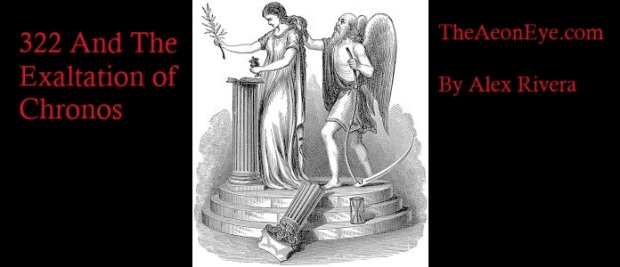
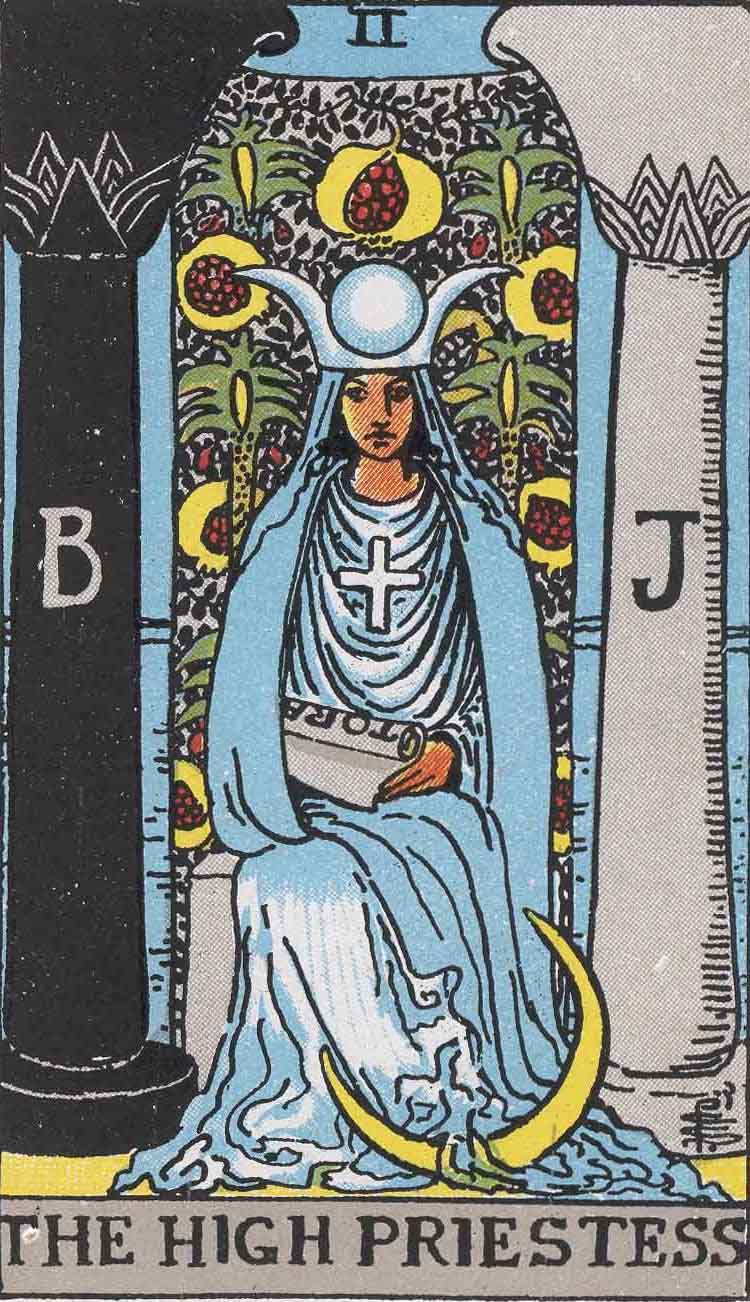
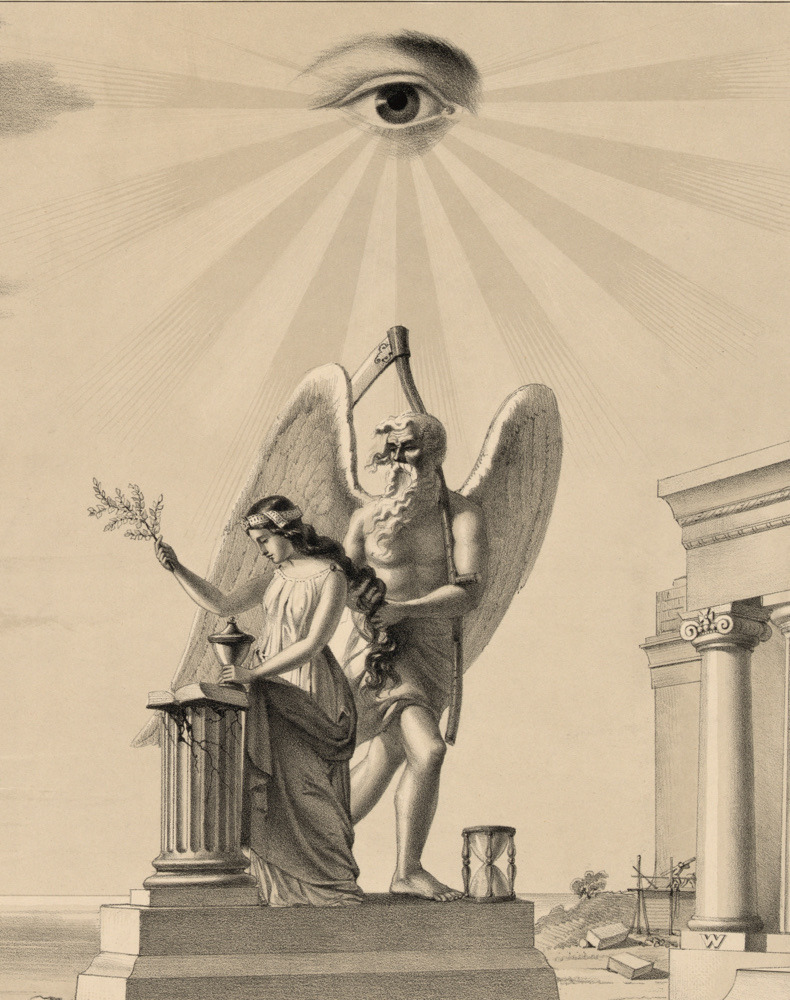


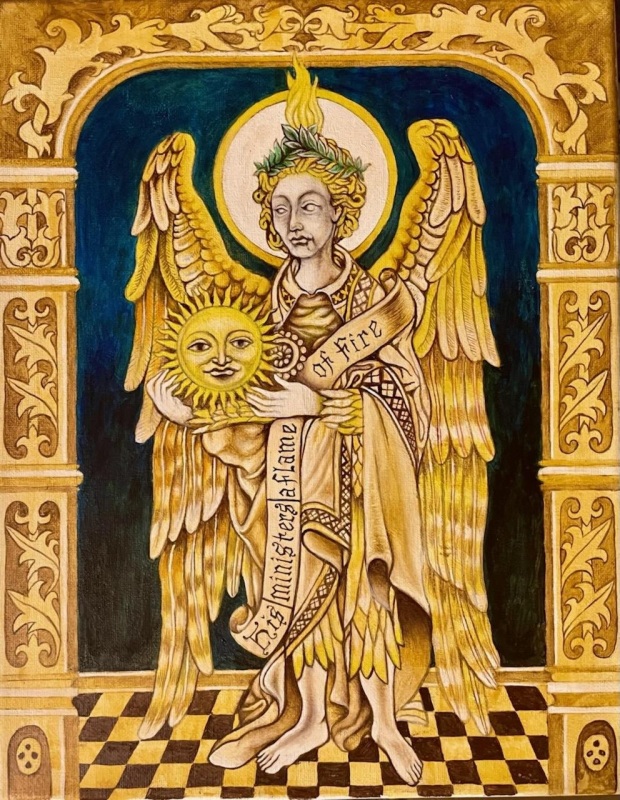
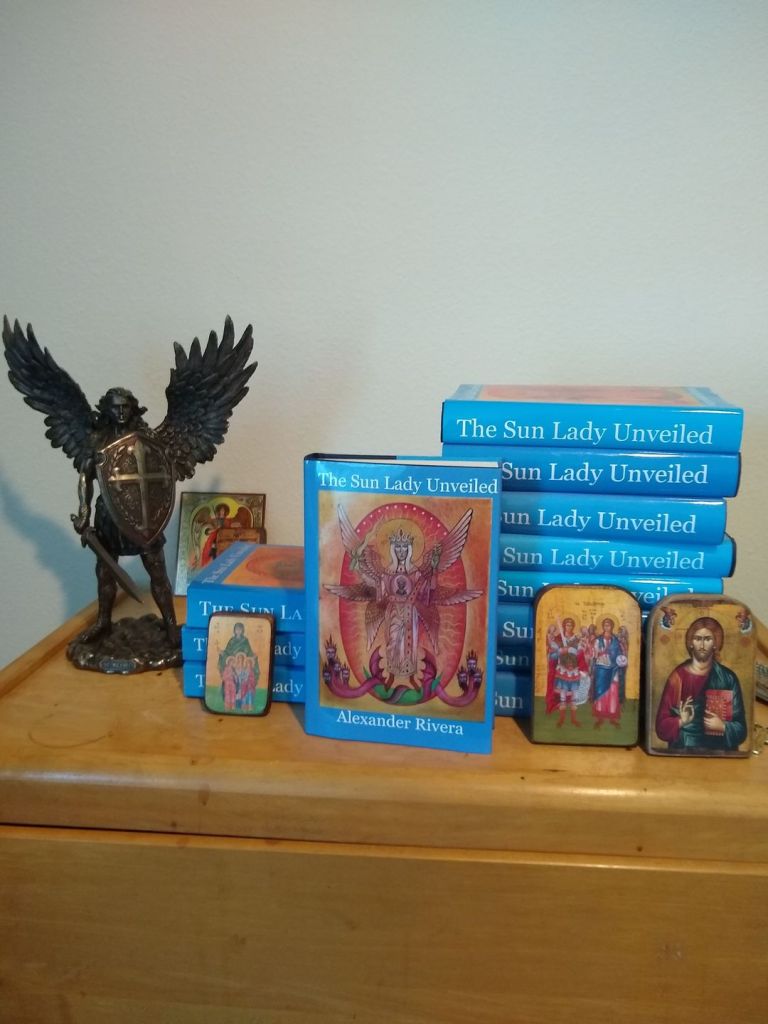


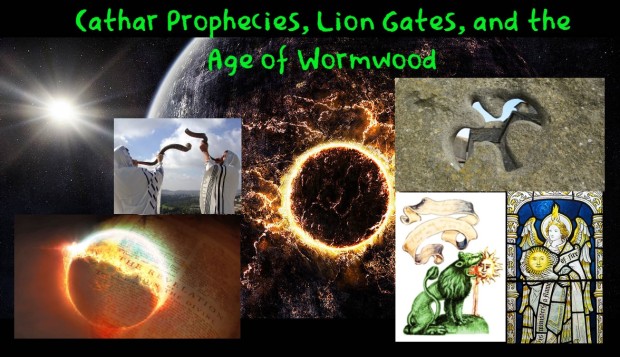


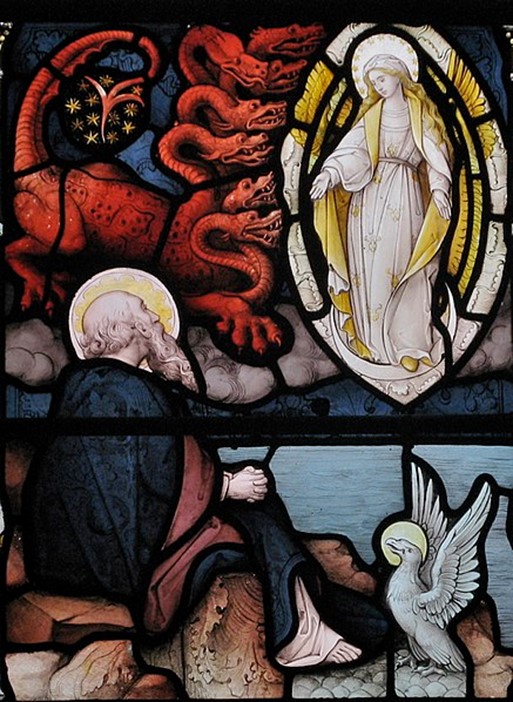


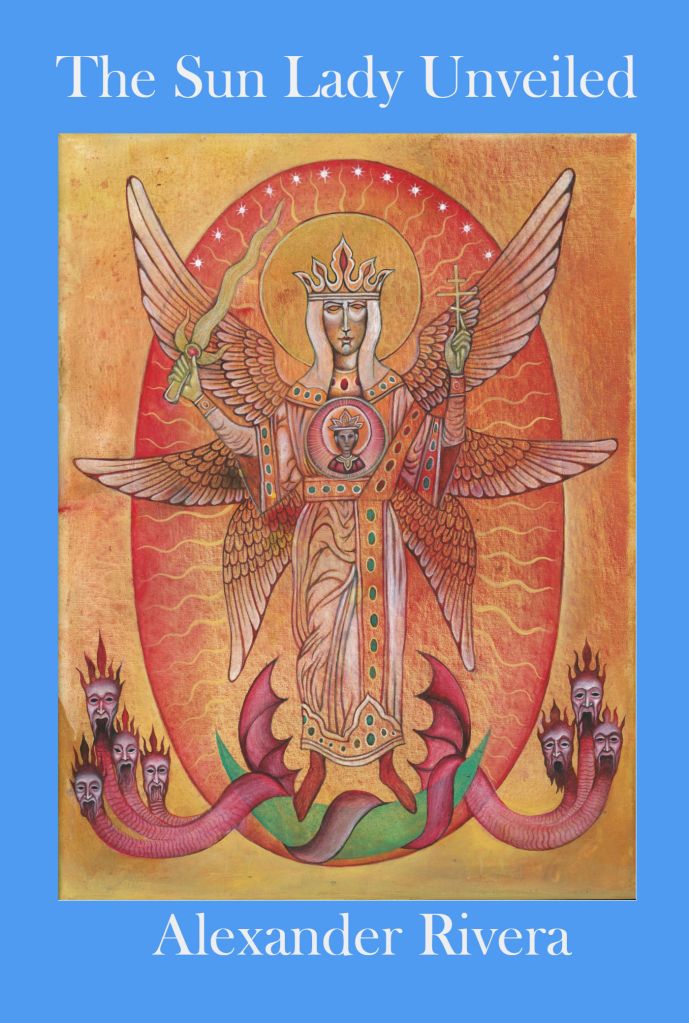


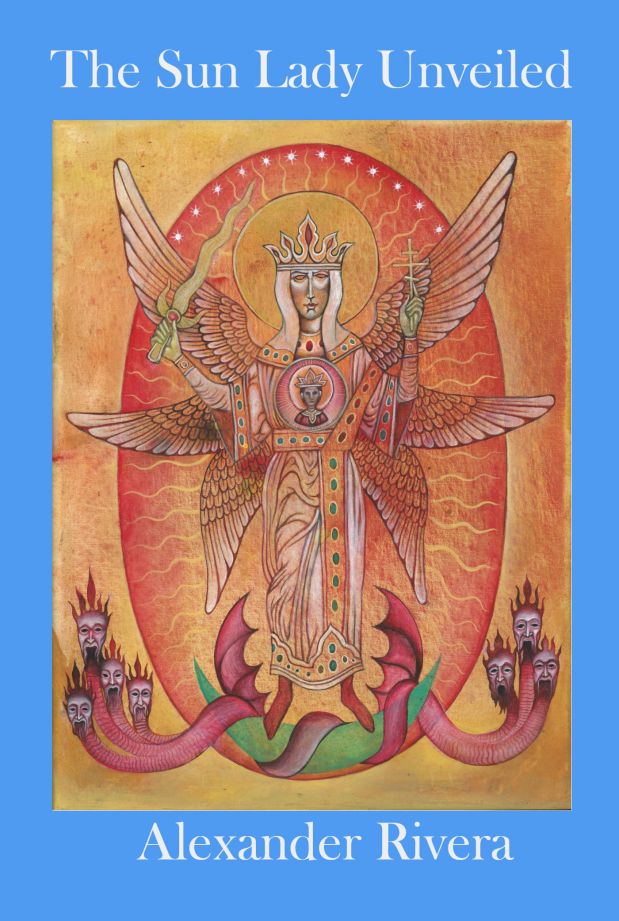
 The Aeon Eye